In-depth interviews are one way to get into the hearts and minds of people related to the field of contemporary studio art jewelry—whether they are artists, curators, collectors, educators or our very own members.

AJF interview 2010: Benjamin Lignel

Frederic Braham

Benjamin Lignel is curator of Also Known As Jewellery*, an exhibition of French contemporary jewelry that has been traveling the world.

What is Also Known As Jewellery*?
Also known as Jewellery
is a traveling exhibition of French contemporary jewelry. It features work by 17 makers, who are either French, or have lived in France for long enough to fool the baker when buying their baguette in the morning. The work selected was created, with very few exceptions, within three years of the project’s inception, and is meant to showcase what we described in the catalogue as the ‘more conceptual’ branch of French contemporary jewelry: i.e. jewelry which puts the practice itself at the heart of its experiments. The show was curated by Christian Alandete and myself: he trained as a curator, and has numerous exhibition projects to his name (both in the applied and the fine arts), I trained in art history and furniture design. It was one of the first projects undertaken in the name of the recently created la garantie, an association for jewellery.

Monica BruggerWhere has it traveled?
The exhibition was launched in March 2009 at Flow, in London, and was then hosted by Alternatives in Rome, and Velvet da Vinci, in San Francisco. Our last host will be Idar-Oberstein’s Villa-Bengel, where the show will spend the summer, after a brief but most exciting stop at the Institut Français of Munich, where it is currently presented to coincide with the famed handwerksmesse (from the 3rd to the 9th March).

The first three venues are commercial galleries which were part of the project from the word go. In fact, the word go would not have been uttered had they not enthusiastically endorsed the project: they opened their doors to us, funded the invitations and opening party, were responsible for reception and re-shipment of work, and took care of local public relations. Given the nature of the exhibition, and its rather low commercial viability, theirs was a very big commitment (for which we are really, really grateful). The latter two venues have no commercial interest in the venture: they must have found the project solid and interesting enough to host it.

To show in such different places - different both in terms of gallery set-up and audience - almost means doing five different shows: for even if the pieces had remained the same throughout (they did not), the exhibition itself would have been re-configured to suit each gallery, and re-modeled - as it were - by the very contrasted expectations of each population of visitors.

Sophie HanagarthHow did the exhibition and catalogue come about?
I suggested the idea for a ‘French’ show to Yvonna Demczynska, the owner of Flow gallery, during the vernissage of an Italian show she hosted in 2008. No one participating in the conversation could remember seeing a French show: in fact, very few knew the work of more than a couple of French jewelers. This in turn determined the dual agenda of the project: give French jewelers as much exposure abroad as possible, and provide visitors with a comprehensive critical tool to access their work: hence the long tour on the one hand, and the catalogue on the other.

The original plan also included a French stopover, for our French contemporaries are painfully ignorant of the fact that such a thing as contemporary jewelry exists (there are exceptions – you know who you are – and things are improving slightly, but there is quite some way to go). This has not yet materialized, and may prove to be the one big frustration of the project.

KampfertWhy did you think it was important to undertake this project?
Recent projects have given the French jewelry ‘community’ a sense of itself (notably, the exhibition Un vrai Bijou organized by Christian in 2005, which brought together 51 makers), and shown that excellent – if confidential – work is being made in France. Yet, while French makers have been thriving creatively, given the adverse odds they face, they do so in relative insularity: the French scene is too small to attract much foreign attention, and its proponents are not well represented abroad. This isolation is a complete anomaly in a very international field, and we therefore thought that showing these makers’s work as a group to the outside world would prove salutary to both it, and them: i.e. by providing international exposure to those artists who have had little of it, and by making their work part of the current world-wide conversation on, and with, contemporary jewelry.

How did you select the jewelers for the exhibition? The writers for the catalogue?
Certainly, the selection reflects the aesthetical and conceptual affinities of Christian and myself: we both like work that tiptoes the invisible fault-lines between craft, fine arts and design, and which makes the most of that ambiguous position. This is a very vague selection parameter: we did not particularly care to have a coherent, seamless selection, but only that the work be of a very high standard, and that the exhibition reflect the diversity of experimental approaches present in France. The selection itself was quite simple – simplified to some extent by the limited number of makers, and further by the clear artistic choices that all of them have made. By no means does it represent the whole spectrum of French jewelry, contemporary or not.

As said before, producing a catalogue was fundamental to the project. We wanted to provide visitors (or readers) with multi-layered information about each artist, and chose an editorial approach that favored individual practice over a group study. In effect, the catalogue is made up of seventeen folded and rubber-bound posters. It can be read as you would a book, by leafing through the pages in sequence; or taken apart and enjoyed as a set of posters.

Each poster is treated as a self-standing publication, featuring a series of studio pictures shot specially for the catalogue (and in some cases pictures of older work for added background), a portrait of the individual artists wearing one of their pieces, a short C.V. and a 500 words essay written for the publication. Makers were offered the possibility of suggesting a writer (some did), but in most cases they were ‘matched’ with writers we felt would do their work justice, chosen from a wide range of disciplines: poet, artist, sociologist, philosopher, historian, anthropologist, gallery owner, curator. While looking for seventeen writers, coming at them with the bargaining power of two beggars on the dole, we found, surprisingly, that a lack of institutional interest for jewelry wetted the appetite of researchers. It afforded them a sort of intellectual terra incognita with more than circumstantial relevance to their ‘legitimate’ areas of research. Only two people turned us down out of nineteen who were approached.

Catherine LegalHow would you summarize the argument that Also Known As Jewellery* makes about contemporary jewelry in France?
I don’t think it makes one argument about contemporary jewelry in France: it makes seventeen of them - each one with its own history, and very individual ways to relate to the larger phenomenon of international contemporary jewelry (they had been starved, now they want food).

Christophe MarguierDo you think that nationality is a very useful way to think about contemporary jewelry? What is French about French contemporary jewelry?
The case for national ‘traits’, or ‘creative identity’, is a dubious one today, unless one is dealing with either a fairly rigid educational system, a concerted effort to perpetuate a vernacular style, or an artistic agenda that aims to (co-) produce a form of cultural identity. (I say ‘today’, because one cannot argue away the existence of, say, a Flemish school of painting – the product, I would argue, of a different information age, and a different relationship to territory.) A country is often too large a place and its frontiers too porous. More importantly, maybe, I have not found in my contemporaries the desire to exude ‘Frenchness’, whatever that may be. I did find some common fields of enquiry (gender, identity), a pretty conceptual bend (a self-fulfilling prophecy, as this was a selection parameter), a certain economy of means they all seem to share – but nothing as conclusive as the smell of a ripe camembert.

If there is such a thing as heritage, or lineage, I would argue that its strands are best seen in the tutor/student relationship. Contemporary jewelry is unusual (compared to design, say, or the fine arts) as long teaching tenures on the one hand, and a relative scarcity of schools on the other have allowed teachers to thrive, and their varied influence on students to be both quite visible and visible over time. Brune Boyer and Sophie Hanagarth in France, Otto Künzli in Germany, Caroline Broadhead in England are good examples of a ‘background’ that informs the way students approach the trade, and allows them to bloom.

Amandine MeunierHas it been successful?
Contrary to popular wisdom, I believe that translation is invigorating for any work of art – showing work coming from place A in place B, and finding how re-location has affected its capacity to inspire. From that point of view, the show’s success has been spectacular, as it engaged – and was commented on by – three very different crowds at its openings. A very academic crowd in London, necessarily well equipped to ‘get’ the show as a whole, and to relate to individual pieces; they were kind enough to acknowledge that French jewelry did, in fact, exist, bless them. In Rome, a mix of regular clients and uninitiated guests, who found themselves irked and excited in almost equal measures by conceptual propositions that are quite alien to the subtle material poems and technical pyrotechnics that are the hallmark of the Padua school. A roster of militant collectors and jewelry lovers in San Francisco, very sympathetic to the agendas of some of the makers (gender, corporeal identity), and quite committed to saying so.

Along the way, all of the 70-odd pieces featured in the show have been re-evaluated, re-interpreted, and re-appropriated by the curators who followed the exhibition, the spaces it was shown in, and the visitors who came to see it. I personally found it extremely rewarding and not a little surprising to see how context could modify the impact of different pieces. Munich will certainly be an interesting test, as the exhibition has to compete with many other equally seductive propositions . . .

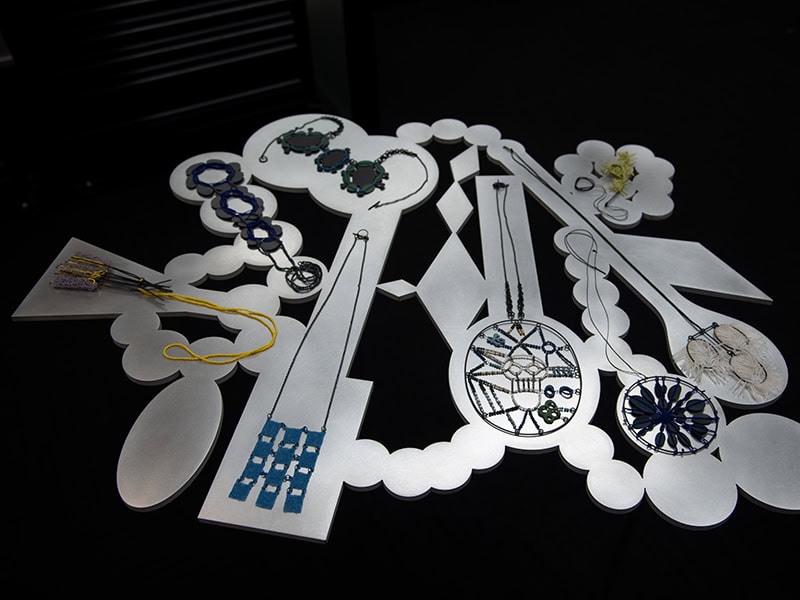
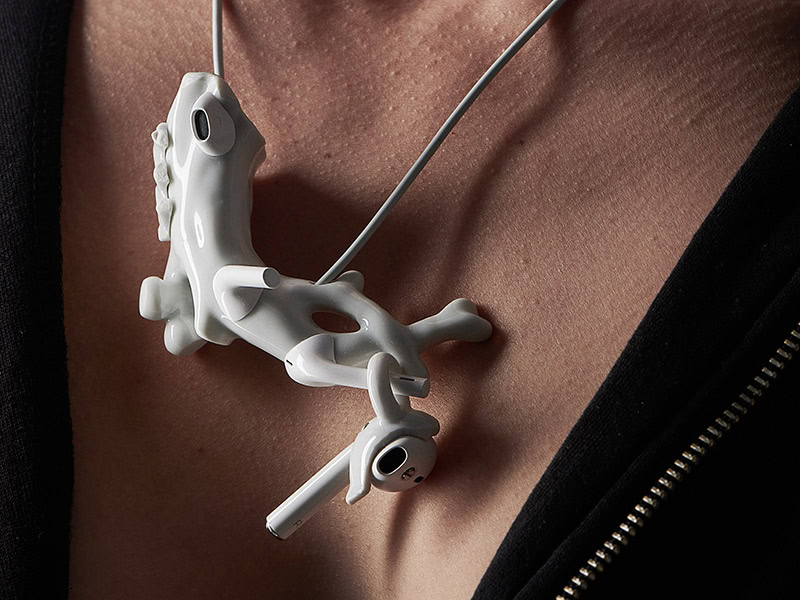
PHOTOS (top to bottom)
Frédéric Braham
Beauty Tool – per abbellire e purificare le parole
2006
metal lipstick (by Terry), gold 920
unique piece

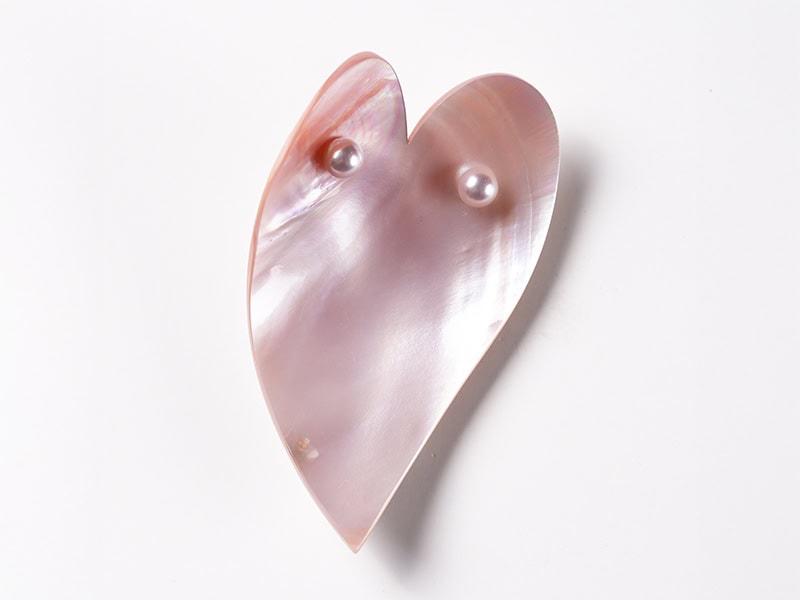
Monika Brugger
Marianne as roberts
2008
brooch
silver, gold, steel, fabric
nº1/7

Sophie Hanagarth
Goldshit II
2009
brooch 
pale yellow gold, stainless steel
unique piece

Ulrike Kämpfert
Hedgehog
2004
two rings
silver, iron wire
unique piece

Emmanuel Lacoste
Langues (two pieces)
2006
tongue jewel
fine gold
limited edition of 8, plus 3 A.P.

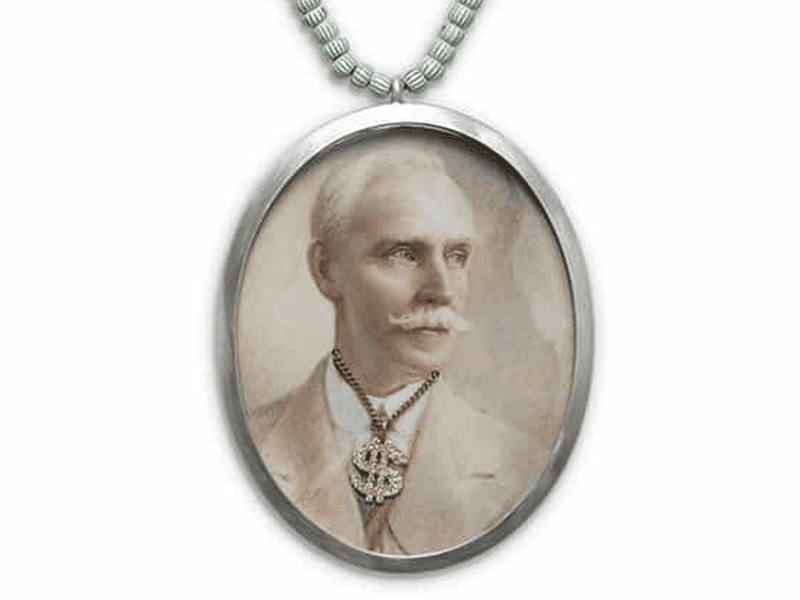
Catherine Legal
Under Over & Souvenir
2004
brooch-medals
silver, ribbon, silicon & silver, culture pearl, ribbon
unique pieces

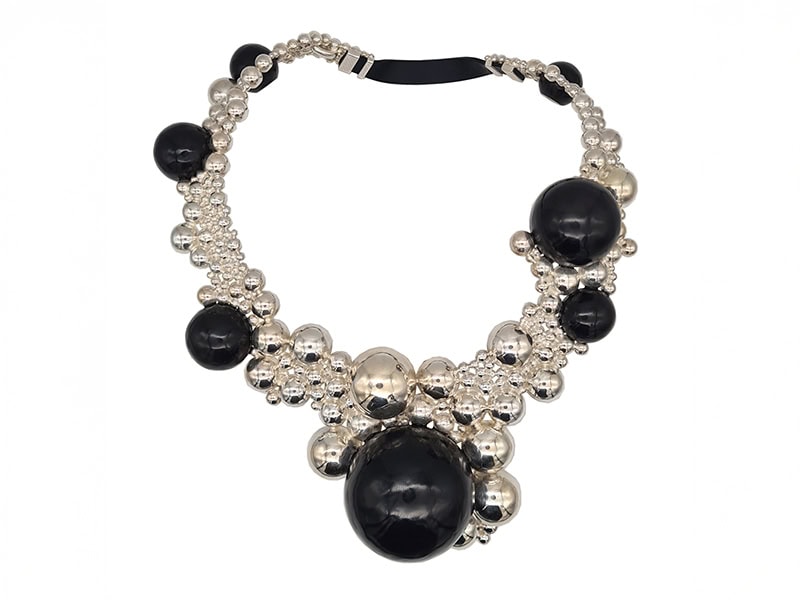
Christophe Marguier
In memory of our childhoods
2005
solid silver, gold plating
prototype for a planned edition of 8  prototype d’une édition de 8

Amandine Meunier
Roads never travel
2008-09
3 cut inner tubes 
triangles - Ø 37 (tube), Ø 6 (section)
Michelin airstop - Ø 40 (tube), Ø 7.5 (section)
made in Poland - Ø 57 (tube), Ø 16 (section)
unique pieces

Full

AJF Interview 2009: Bruce Pepich

Bruce Pepich

Bruce Pepich has been the director of the Racine Art Museum for more than thirty years.  In the course of his tenure there he has implemented many programs and raised the profile of the institution to one of a nationally recognized center for craft and the arts.  His engaging personality and devotion to the institution is infectious.  Pepich is an ardent supporter of craft as well as the artists who create it.  In an essay in the 2008 SOFA catalog, he commented on the importance of encouraging artists so that they will continue to create new work.  This is done through the museum but also through collectors, who are a key part of the artist’s support system.   Since the early 1990’s, Pepich has actively embraced the world of art jewelry.   RAM has shown exhibitions of both Arlene Fisch’s and Jamie Bennett’s work in the past few years.    
 RAM recently was presented with 49 pieces from Donna Schneier‘s collection of art jewelry through Schneier’s personal donation to the museum.   These new pieces both complement and augment RAM’s extant collection.  It was in this context that I posed these questions.

RC: Please tell us something about your background?  Where did you study?  Do you have special interests within the “world of craft”?

BP: I have a degree in Art History from Northern Illinois University in DeKalb, Illinois. It is about 60 miles west of Chicago and had a large visual arts program with close connections to the Chicago arts community. My area of concentration was Contemporary Art. While working on my degree, I served as the university’s first curator of the campus collection and also worked as a volunteer arranging exhibitions in the Student Union Art Gallery. The Union Gallery hosted two regular national competitions—a print and drawing show and a craft competition—and purchased works from these shows for the collection. From these early experiences, I was very comfortable working with works on paper

alongside works in contemporary craft media. I always saw these works as being on the same parity level. I was able to carry on this interest in bringing craft together with painting and sculpture when I began organizing exhibitions in my first museum job.

RC: How long have you been at RAM?

BP: I was hired by Racine’s Charles A. Wustum Museum of Fine Arts straight out of college in 1974 on my way to graduate school. I soon realized I was able to conduct original work in the field on a daily basis there and stayed. RAM opened in 2003 as an outgrowth of Wustum Museum and as home to its permanent collection. In the 1990s, I established one of the most significant contemporary craft collections to be found in any US art museum at Wustum. I continue to oversee Wustum as our visual education campus. RAM, located two miles away in Racine’s downtown development district, is where we present artists with national and international reputations. I am celebrating my 35th anniversary at the same institution this year and have been Executive Director since 1981.

I have had an incredible amount of freedom in creating this collection over the past three decades. Knowing I have personally walked most of the works in the 4,500-piece collection into the museum has provided me with an intense relationship with this museum and its core mission. This unique opportunity has held me at RAM. I have also had an extremely supportive relationship with RAM’s major donor, Karen Johnson Boyd.  She inaugurated RAM’s Art Jewelry collection with a gift of about 30 major works in 1991. We share many beliefs about blending art from a variety of disciplines and media and a respect for the artists. It is easy to do good work when you are supported and encouraged as a professional and this environment has provided that for me.

RC: Tell us about the museum’s acquisition of the Donna Schneier collection.   Other parts of the Schneier collection went to MAD and to the Met. What is unique about the body of works now at RAM from Schneier collection?

BP: Donna Schneier began collecting Art Jewelry in the 1980s and eventually assembled a collection of about 600 pieces. She was primarily attracted to jewelry created in non-precious materials. In 2002, she made the first gift from her collection to a museum and Donna Schneier presented approximately 80 pieces to the Museum of Arts and Design in New York. Following this gift, she broadened the parameters of her collection and added adornment in precious materials. In 2007-2008, she and her husband, Leonard Goldberg, presented a collection of about 200 objects to the Metropolitan Museum of Art in New York and 49 works to RAM. Both museums have received works in both precious and non-precious media.

The gift of the Schneier Collection impacts RAM’s jewelry holdings in two important ways. First, it brought new artists to the collection with the first examples of their work. Secondly, it contributed additional examples by artists we already have in the collection. In some cases, the Schneier Collection adds examples of jewelry by artists whom we only represent by hollowware pieces. In other cases, these new acquisitions enable us to document our major artists in depth. We collect jewelry artists with multiple examples, as a major museum would with its print and drawing collection. We are interested in documenting career development over a period of time, demonstrating how ideas and aesthetic concepts come about and change. Works in the Schneier Collection dovetailed with these interests of mine, as Curator of Collections, and the museum’s mission to support artists and their careers.

RC: Did Donna Schneier have an overall philosophy for collecting?

BP:  Donna Schneier was very interested in acquiring works that made aesthetic statements—pieces that she believed referenced the history of fine art and elements of popular culture in much the same ways that contemporary painters and sculptors used these resources for inspiration. She saw these works as wearable sculptures. She was attracted to the size and portability of jewelry; she could wear the artworks she collected. She was not interested in creating an encyclopedic collection or a historic documentation of the field. She concentrated on acquiring pieces that interested and intrigued her. The collection was originally displayed in the offices she maintained for her commercial wholesale gold jewelry business. Donna Schneier displayed works from her collection to demonstrate the possibilities existing in this work to buyers from commercial jewelry stores who came to do business with her. I think this aspect of teaching is something both she and RAM have in common with their Art Jewelry collections.

RC:   Is the Schneier collection at RAM principally the work of American or European artists?

BP:  The bulk of the works in the gift to RAM were created by American artists or European artists now living and working in the US. We do collect international figures and while the collection is primarily American artists right now, we are actively acquiring European, Asian and Australian artists and we plan to continue doing so. Art Jewelry is such an international field that we believe it transcends geographic boundaries. Each work was selected by us on a case-by-case basis, depending on how it helped fill holes in the permanent collection.

RC:  Who are a few of the outstanding artists within the DS collection now at RAM? 

BP:  Although some of the included artists do teach, this gift includes individuals who are primarily known as full-time studio artists and this was one of Donna’s intentions. The gift includes examples of work by Barbara Heinrich, Esther Knobel, Nel Linssen, Thomas Mann, Bruce Metcalf, Myra Mimlitsch-Gray, Ruudt Peters, Kiff Slemmons, Tone Vigeland and Martina Windels. The pieces range from the early 1970s through the early years of the new century.

RC:  How does the DS collection complement the extant collection of art jewelry at RAM? 

BP:  The Schneier Collection helps us explore artists’ bodies of work in depth. For example, we already had a number of enamel vessels by June Schwarcz, spanning a number of years. The Schneier Collection includes a relatively rare example of a cuff bracelet created by Schwarcz. The form of the bracelet is handled in the same folded way this artist approaches her vessels, but it broadens the understanding of her entire body of work to make these connections. Donna Schneier also gave us a large neckpiece by Christina Y. Smith. It has male figures and everyday household objects hanging like amulets. These same figures are part of a hollowware teapot by Smith already in RAM’s collection. These kinds of relationships were in our minds when we made our selections from Donna Schneier’s collection. This gift includes precious materials employed by artists such as Mary Lee Hu and Harold O’Connor and at the same time it also includes an elaborate neck collar in polymer by Pier Voulkos.

RC: On a bigger scale, how does art jewelry fit into the totality of the collection at RAM?  Do you see relationships between jewelry and other fields of specialization? 


BP:
 We see a constant interface taking place between RAM’s Art Jewelry holdings and other portions of its collection. Since a majority of RAM’s jewelry collection is works in non-precious materials, there are many opportunities to overlap from the field of adornment to other areas of expression. As an example, the Schneier collection brought neckpieces by Garry Knox Bennett and Beatrice Wood to RAM. The museum already owns furniture by Bennett and functional and sculptural ceramics and a drawing by Wood. For the debut show of the Schneier Collection, RAM combined the Schneier pieces with examples of works by the same artists already in the collection. This demonstrated which works brought the first examples of an artist to the museum and also showed how multiple pieces assist us in presenting more detailed glimpses into the bodies of works of these artists. The exhibition incorporated jewelry, hollowware, handmade books, furniture, ceramics and works on paper. This actively demonstrates the many connections that exist between Art Jewelry and other media.

RC:   What are RAM’s plans for future art jewelry acquisitions?  What are your criteria for adding new work(s) into the collection at RAM?  Are you looking for specific artists?  Does the museum only seek a whole collection or are single significant pieces of interest?  How important are donations versus purchases in the building of a collection? 

BP:  We have a small acquisitions endowment fund, and have used the income it generates to make a few acquisitions. For the most part, we are dependent upon the gift of actual works to build the collection. We are constantly seeking new additions through gifts of works from collectors and artists. Although we are talking here about a 49-piece collection coming to RAM, but we also accept single works offered to the museum and celebrate their arrivals. I just find that with the way most collectors assemble jewelry collections, they usually offer us multiple works—say four to 15—at a time. We certainly welcome single pieces, in fact, we are always seeking to fill holes and if we have to do this one step at a time, we do. We do have a wish list that we work off of in determining what we need to acquire to create the most detailed and well-rounded representation of the field. I am always interested in seeing the work of artists who are mature in their career development, but new to me.

RC: What recommendations would you make for AJF readers/collectors that might help them select the best museum for donation if they are interested in that opportunity?   

BP: Many of our donors select RAM because they are interested in our philosophy of how we utilize the collection for changing exhibitions and to conduct programs of public education. RAM completely changes all of its galleries three times each year. This accommodates both temporary shows brought in from the outside and also rotating thematic shows curated from the collection. It is the constant rotation of collection works to place them in different contexts that gives a constant sense of life and vitality to RAM’s collection.

I would suggest that collectors examine not only how a potential museum recipient exhibits its collection and how often works come out, but also take into consideration the kinds of education programs produced in conjunction with these shows. How will the museum live with these works after they enter the collection? What will the museum’s programming do for the understanding of the field, the advancement of the artists’ careers and the encouragement of further collecting and new artists?  We currently have collectors living in 30 different states whose works come together here as a historic documentation of the development of this field at this time in history. We are grateful to collectors like Donna Schneier and Leonard Goldberg for this kind of generous support of our efforts.

I also like to remind artists that they own important archives. Not only do they have examples of their own work, but also the work of others, plus their paper archives. These must all be properly managed and treated seriously as part of our nation’s heritage.

The exhibition:  Art Jewelry of the 1980s and 1990s: The Donna Schneier Collection is currently on view at the Racine Museum of Art, in Racine, Wisconsin through January 3, 2010.  In lieu of a visit, one can purchase the 16 page catalog from the RAM Museum store for $5 plus $1.50 s/h.    Please call 262-638-8200.  

IMAGES
Bruce W. Pepich, Executive Director and Curator of Collections

Christina Y. Smith, Neckpiece with Amulets, c. 1995,Sterling silver,Racine Art Museum, The Donna Schneier Jewelry Collection, Gift of Donna Schneier and Leonard Goldberg,Photography: Jon Bolton, Racine, WI

Pier Voulkos, Neckpiece, c. 1995,Polymer clay and wire, Racine Art Museum, The Donna Schneier Jewelry Collection, gift of Donna Schneier and Leonard Goldberg, Photography: Jon Bolton, Racine, WI


Full

AJF Interview 2009: Ulysses Dietz

Ulysses Dietz

When you’re born with the name Ulysses Grant Dietz, you just might have come into this world with a penchant for leadership. Luckily for the art jewelry community, Ulysses turned his attention not to military or political affairs, but to a life’s mission of preserving, protecting and defending his nation’s artistic heritage.


As Senior Curator and Curator of Decorative Arts at the Newark Museum, with its 80 galleries of display space, he oversees a collection that begins with jewelry but ranges out to ceramics and silver as well. In other interviews, both in print and on video, Ulysses has been labeled as a “national resource,” a man with “encyclopedic knowledge (who) has helped put the Newark Museum on the map as a vanguard of modern decorative arts.”  


When you talk to Ulysses, it’s clear that he carries a love for the objects in his collection almost as much as the attachment for his own children. That’s why he refers to museums as the proper home for things of fragile beauty, because “it’s safe.” Protecting the precious, whether infants or aged art jewelry, is a mark of the character of Ulysses Grant Dietz.


In a recent interview, Elise Winters asked him about his background as a curator.


EW  Where were you before Newark? 

UD  My training as a decorative arts curator began in 1978 with a graduate program through the University of Delaware. I was a graduate fellow at the Winterthur Museum outside of Wilmington, starting at the Newark Museum in 1980 with a special interest in the 19th century and then expanding since then to the present day. I’ve been particularly interested in jewelry more recently, especially as it connects to the decorative arts.


EW  How did you get your reputation as a jewelry historian?

UD  That goes back about a dozen years to the 1997 show, The Glitter and the Gold, an exhibition I co-curated with Janet Zapata about the gold jewelry industry in Newark. A lot of people might still be unaware that Newark was the center of solid gold jewelry manufacturing from the 1850’s to the 1950’s. For decades, there wasn’t a jewelry store in America that didn’t carry Newark’s goods. As long as there was this kind of industry in America, Newark was its capital, producing 90% of the gold jewelry in this country at its peak. For instance, there was Krementz and Company, the last survivors. They didn’t sell under their own name, but manufactured for Cartier and Tiffany in their Newark factory. It was a kind of industry practice to remain anonymous in favor of the retailers. In our newest gallery today, there’s a section on Newark jewelry.


EW  I’d like to know more about the new gallery. 

UD  We’ve just opened this last Augus t-- the Lore Ross Jewelry Gallery. Mrs. Ross left the Museum a large bequest and we named a permanent jewelry gallery in her honor. In the gallery we have jewelry from the 1600’s to the present day. Even without extensive publicity, people in the jewelry world have come to see the collection and learn about it. In the museum, we’ve created a context for Newark’s jewelry, but have long had a focus in acquiring European and American work as well. For instance, we bought two pieces of George Jensen jewelry back in 1929.


EW  How does your jewelry collection serve your local community in Newark?

UD  We think of our local community as all off the 2.5 million people in northern New Jersey. And yes, we think that jewelry is of interest to everybody, and that the interest is endless.


EW  Why would the Newark Museum be an attractive venue for jewelry donations? If somebody is interested in donating, there are so many other prominent places that would come to mind.

UD  Well, let me admit that the Met does have glamour that we can’t match, and frankly it can get anything that it wants. But really, what can you give them that they don’t already have? I can make a clear claim that we are more committed to jewelry than most other American museums –including the Met-- are. Our dedication to jewelry as a medium is well established with the galleries we have built.


Collectors have donated to the Museum of Art and Design, but MAD’s interest centers on contemporary studio jewelry, both wearable and unwearable. For me, wearability is crucial; I can’t buy a piece of jewelry that can’t be worn.


To us, contemporary art jewelry fits in as a component of our larger vision about what constitutes the decorative arts. The way my department collects is to document interaction between design and production in daily life. This is a museum of objects that interact with the way people live. And I believe that when people visit the Newark Museum they come to see jewelry that informs, that sheds light on history.


AJF Note: Ulysses Dietz has recently added Dream House to his long list of publishing credentials.

Full

AJF Interview 2009: Sharon Massey, 2009 Emerging Artist Award Honoree

Sharon Massey

As a Pittsburgh-area native who had left the area some time ago I was thrilled to have the opportunity to return there to meet and interview Sharon Massey, this year's AJF Emerging Artist Award winner and a  recent transplant to the Pittsburgh-area.   While this interview focuses on the emerging artist award, during our conversation I was excited to learn about the burgeoning art scene in my old hometown and I look forward to speaking with Sharon again, to tell us more about it in a future interview.

SK  Did being named the AJF Emerging Artist help your work/career? If so, in what ways?
SM Since the official award presentation hasn't happened yet, I feel like it is a little bit premature to know how the award has affected my career, but there have certainly been some immediate effects on my work. The biggest effect is the sense of validation that the award provides. Having been out of graduate school for 3 years, opportunities for critique and feedback are rare, and sometimes I question whether my work is moving in the right direction. Receiving this award has given me confidence that my work is relevant and worthwhile, and has inspired me to keep working on this series.

SK  Did the award "open any professional doors"?
SM  Again, I think that it is a little early to know, but my work will be shown by Charon Kransen at SOFA Chicago, and he recently used an image of my work in his ad in Metalsmith magazine.
 
SK  What is/are the value(s) other than the monetary stipend, of awards such as the AJF Emerging Artist Award?
SM First of all, it has been such an honor for me to be recognized by my peers as the recipient of this award. It is also very validating to receive an award from such a well-respected organization and group of jurors.  
 
SK  How has your work changed (please feel free to attach visuals) since winning the award?
SM I am still working with iron wire and cotton muslin fabric, but I have introduced color into the fabric, and I have been exploring new ornamental iron patterns. One of the challenges of my work is creating forms with the ornamental ironwork that will accept the fabric, and so it is a fairly slow process to make finished pieces with new patterns. 
 
SK AJF has increased the monetary value of the award last year to $5,000. Would the size of the stipend influence whether you would apply for such an award?
SM The size of the award is definitely appealing, but I had applied in years past as well, so I don't think that money is the most important aspect of the award.
 
SK Does presenting the award at a commercial venue such as SOFA matter to you?
SM I am excited to have the opportunity to present my work at SOFA because it is such a prestigious venue for contemporary craft. SOFA is also exciting because there are so many collectors, curators, and artists who will see my work.
 
SK How has the state of the economy affected your work?
SM I have definitely sold less work in the past year than I have previously, and I have assumed the economy is at least partially responsible. I have also been affected by the rise in prices of gold and silver. Luckily my work is made primarily of non-precious materials, but it is still hard to make as much work as I used to.
 
SK  Do you have any advice for emerging jewelers who might consider applying for the award?
SM I think that emerging jewelers who are interested in applying for this award should try and make their work distinctive and honest. It seems to me that there are a lot of people making well-made jewelry that lacks an original voice. I'm not exactly sure how to tell people to find that voice, but I know that it took me years of long hours in the studio, and a willingness to experiment and fail until I figured out the unique process that works for me.
 
SK  Is there any other information you'd like to share with AJF members?
SM This award came at an ideal time for me in my career, and I am very thankful and honored. After several years of moving around the country for teaching jobs that left me feeling unsatisfied, I decided to move to a city that I love and share a studio with a dear friend from graduate school. In August, I moved to Pittsburgh, PA and I have a spacious studio on the north side. I also started working at Society for Contemporary Craft, a non-profit arts organization dedicated solely to craft. I am very happy with my current situation, and the award from AJF helped not only financially, but also gave me the confidence to make this career change. I hope to have the opportunity to meet members of AJF to express my thanks, and also to talk about the passion we share, contemporary jewelry.
Full

AJF Interview 2009: Leo Caballero, Founding Partner of KLIMT02

Leo Caballero and Amador Bertomeu

Leo Caballero and Amador Bertomeu, both from Barcelona, met in the late 90s while sharing a studio-workshop. In 2003 they began the on-line website, Klimt02 which has become the go-to website for all matters that involve art jewelry worldwide. Last year they opened a gallery space in Barcelona. At this year’s SNAG conference in Philadelphia, Leo gave an informative lecture about the web and its relation to art jewelry. He also attended an informal lunch and discussion with AJF members who were on the Philadelphia trip hosted by Velvet da Vinci owners Elizabeth Shypertt and Mike Holmes. Elizabeth Shypertt asked him the following questions:

ES  What were your motives for starting the website?
 
LC  Amador and I had good rapport right from the beginning, and we used to often have long discussion about art. At some point in one of our typical conversations about work that was interesting to us, I showed Amador the work of jewelers with a creative potential that seemed to us on a par with that of recognized artists in other disciplines. Then we started to explore and we became aware of the lack of information and accessibility regarding the jewelry discipline, along with its scattered nature, mainly in terms of what we considered to be relevant and important work. And with regards to publications, it was very difficult to find up-to-date information. We had the internet by then, a tool which did give us access to this information but in a very scattered way which was not very productive with respect to the time invested and the results obtained.
 
So then we said to ourselves: And why not? Why not bring together and display the information that we would have liked to find? A task that perhaps we would have liked somebody to have done for us?
 
ES  What were your motives for starting the gallery? 
 
Klimt02LC  The gallery was the obvious next step: from virtual to physical. We were showing and sharing all things we considered interesting from the internet platform but felt we had to open a place to show the actual work.
 
ES  Where do you see Klimt02 in five years?
 
LC  Now we are working to make Klimt02 a brand, not just a gallery, publishers or just a platform. The initial concept of the website defined eight years ago is still valid. In five years, we will be making something that most people think is not possible to do for jewelry. We will create a wider and bigger net, collaborate with other galleries, formulate new ways of understanding the market, and leave behind the topics that hold us all back. 

I recommend you read the following texts about Klimt02 to understand more about us:

 www.klimt02.net/about/about_klimt02.php 

and

www.klimt02.net/forum/index.php?item_id=11974

ES  Will you be publishing your talk and/or video from the Philadelphia SNAG conference on line?

LC  Yes, the video can be seen at: www.youtube.com/watch?v=uz6227MCFQc
The talk will be soon published at Klimt02 as we are making a condensed version.

Full

AJF Interview 2009: Helen Williams Drutt English

Helen Williams Drutt English

SC How would you define your collection? Did you start out to fulfill that definition? If not what did you originally think you were doing?

HWDE The MFAH: Helen Williams Drutt Collection documents a segment in the history of our field. It was not my intention to build a collection; it was my desire to hold history, since little public interest was expressed in the late sixties and early seventies. A Whitney museum curator told me to consider acquisitions as if they were heat, electricity, printing, rent, and insurance—all areas central to the operating budget for the gallery; as a result, a segment of history would be saved within my regional realm. Never did I anticipate the national and international future. (Helen pictured above with Cindi Strauss, Ron Ho, Laurie Hall, Nancy Worden and Eleanor Moty at at book signing at the Tacoma Museum)

SC Overall how has your experience been with the exhibition and catalog Ornament as Art? What have you learned from it that other collectors could benefit from? Do you have any unfulfilled wishes?

HWDE The Ornament as Art catalog is an amazing supportive document. It fulfills my wish that the works and artists be permanently recorded before (one never knows) any aspect of the collection is dissolved or deaccessioned. It is a stepping-off point for further research and inquiry, and expands information in the previous book, Jewelry of Our Time, which was written a decade earlier with Peter Dormer. That text incorporated the first comprehensive bibliography and chronology ever published. Cindi Strauss, Kristin Wetzel, and Keelin Burrows were an ideal Ornament as Art research team.

Although I kept abundant records, they were not always precise or available. Records were destroyed in a flood in the basement in 1985, and a brief partnership, from 1987 to 1990, created a situation in which files that I had stored were not released.

As a closet historian, ephemeral materials—that is, photographs, letters, lists, etc.—are essential documents. My unfulfilled desire would be to document those records as support for the actual works. I have decades of faxes and letters in storage cases waiting to be read.

SC Do you think Ornament as Art has effected the curatorial attitude towards art jewelry in other museums? Do you think they have been paying attention? How can you tell?

HWDE It is important to note that the first exhibition of the collection occurred in 1984, at the Château Dufresne, Montreal Museum of Decorative Arts, Canada; it subsequently traveled to Philadelphia, Cleveland, and Honolulu, and in Europe toured Helsinki, Gothenburg, Amsterdam, Ostend, and Zurich. Those venues gave public distinction as well as greater awareness to the works and artists, and served to create a greater discourse among artists on several continents. As it traveled, from 1984 until 1995, the collection grew; then, it was retired from public exhibition, as I continued to develop its base. Ornament as Art was the collection debut after a twelve-year hibernation and growing period.

Ornament as Art has acted as a catalyst for other institutions, but that may be a pretentious notion. The Daphne Farago Collection is a permanent part of the Museum of Fine Arts, Boston. Donna Scheier has given her alternative material works to MAD and other works to the Metropolitan Museum of Art. Major collections in Europe flourish at the Pinakotech der Moderne, in Munich, and the Stedelijk Museum, ’s-Hertogenbosch, The Netherlands—all excellent collections. I cannot enter into the minds of curators, but I have observed that Elisabeth Agro, at the Philadelphia Museum of Art, has begun to break down the barriers among the national and international departments and, as a result, increase the museum’s bounty. The Tacoma Museum of Art collection, which is dedicated to regional work and works influenced by the Northwest, is continually building. The collection at MAD has a great base of works, other institutions with noteworthy collections include the Mint Museum of Art among others. There are private collectors waiting to be discovered by a curator. Has the MFAH sparked this increased interest among the other institutions and collections? I would say yes.

SC What are your thoughts on your future collecting? What are you looking for now?

HWDE When the collection entered the MFAH, I thought it was time to retire. I believed that the next generation as well as emerging collectors could document their vision, offer other points of view and responses that would provide expansive information and include artists and territories not known to me. The desire to document, however, doesn’t diminish or die. If it is in your blood, the surge cannot be halted. I found that it was an opportunity to reflect about missing works—filling in the voids within the spectrum that I had selected to observe—and, to my surprise, to begin examining another generation.

SC Would you like to mention any exciting young new artists you have discovered?

HWDE What is meant by young – age or recognition? My interest in works by Helen Britton, Melanie Bilenker, Kadri Mälk, Iris Nieuwenburg, Karl Fritsch, and Kyoko Fukuchi began to develop, as well as those artists whose work I missed—earlier works by Kiff Slemmons, John Paul Miller, Ron Ho, Eleanor Moty, and Yasuki Hiramatsu. I’m looking back as well as forward, not necessarily for acquisition but certainly for information. I began to commission works by the artists that celebrated important occasions—for instance, Gijs Bakker’s festschrift book cover for my husband Peter Stern’s eightieth birthday, and Gerd Rothman’s silver fingerprint bowl, which documents the family upon the same occasion, or a necklace of my 104-year-old mother’s fingerprints.

SC What do you think about computer produced jewelry, which is so strongly represented in your city–Philadelphia–at the Tyler School?

HWDE The survival of the hand in a mechanized society is fundamental to me. I understand the importance of technology and what can be created, and, actually, I’ve begun to appreciate the work. The primary experience of direct contact with material cannot be replaced; its visual presence dominates the artwork and reduces anonymity. We must advance with our time in history, however. In an accelerated world, does the wish to devote three months to one work still exist? I hope so!

SC Any advice you would like to pass on to collectors and curators?

HWDE Trust your own responses. I believe it was Matisse who said, “One foot in the museum and one foot in the world.” Trust good guidance; look at everything.

Recently, I visited three collections. Only one was unique to the individual; two looked as if acquisitions were guided by a textbook and had no personal input. One’s instincts are essential to building a collection, whether it is an in-depth examination of an artist or concentration on a position—that is, narrative, minimal, or abstract—regional, national, or international. Each collection will have merit. Go for it!

Full

AJF Interview 2009: Nancy Worden

Nancy Worden

Artist statement from Loud Bones, The Jewelry of Nancy Worden published by the Tacoma Art Museum, 2009... "My work is inspired by the events in my life as an American woman. I can review the major issues I’ve dealt with through the years just by looking at my slides. While the content of my pieces is very personal, I have tried hard to distill the essence of each situation so that many people can relate my imagery to their own experiences. This autobiographical journey is intertwined with an exploration of materials from contemporary American culture and an intensive study of the history of jewelry design from around the world."

How appropriate that a farm near Quilcene, Washington now houses the Olympic Music Festival. It is on that farm that Nancy Worden lived her formative years. With a paper-bag lunch and instructions to “Go play! See you at dinner!” Nancy was free to explore. She’s been exploring ever since.

KL Tell me about your early years.

NW My parents were college professors. Even though no one in my family was a visual artist, they gave me a life built on the arts. They exposed us to the theatre, dance, music, the public library. They put a high regard on quality. We were readers. We talked about ideas. We were a household of makers.

KL Why did you choose jewelry?

NW My sophomore year of high school in Ellensburg, Washington, I was taking a print-making class. Immediately after our class, was a senior class in jewelry making. I stood at the door watching, and knew, “That’s it! That’s what I want to do!” I began taking the class as a junior and I never looked back. In college I was privileged to study with Ken Cory. He demanded we learn the technical skills required of jewelry makers and he required we develop good ideas. In college, I began using found objects as a way to get color in my work and because I lacked the technical skill to duplicate the forms in metal. I still use found-objects, American found objects that are common to the lives of women of my generation, to give my work a specific chronology.

KL Where do your ideas originate?

NW I go to an inner place in myself. My goal is to give the viewer comfort. People who love and purchase my work see themselves in it. My art has kept me sane. The show, Loud Bones, is the capsulation of my journey. The show consists of forty pieces, shown in chronological order. However, for every piece in the show, there are twenty pieces that did not make it into the show. It has been a difficult, demanding journey, but an exciting journey!

KL Take me through one piece, tell me the journey.

NW This piece is entitled: Literal Defense. Here’s how it happened: I was at a retreat in Canada, Hollyhock Center. When I go there, I take classes that put me out of my comfort zone. Hard to believe, but I took dancing. I loved how it stretched me (literally and figuratively). Another group at the center was studying astrology. That group didn’t understand the art of dancing or art at all. A divide became apparent. Every day felt like a battle. To remove myself from the fray, I began sketching a piece of armor: Literal Defense is that armor. The piece is constructed of aluminum pots, aluminum cookie sheets, an aluminum handle from an ice-cube tray (each carries the patina of the kitchen). I’ve inscribed every inch with words: words from Billy Collins, words from Joseph Campbell, words from Ovid. Words in defense of art. The finished project is light, wearable, full of meaning. That’s how one idea grew.

KL Why jewelry?

NW Jewelry is personal. The day after 9/11, I took my collection of mourning jewelry to share with my students. I wanted them to understand that jewelry is not frivolous; it is intertwined with our culture, our very being.

KL Advice for younger artists?

NW You must believe in your own work. If you don’t, who will?
- Don’t be afraid to put yourself out there.
- Publicity isn’t about ego, it’s about business.
- Make yourself visible!
- Find a business mentor: get a job at a gallery, a jewelry store, or a jewelry manufacturer.
- Be a part of selling your work. Don’t expect your gallery to do all the work.

KL Any closing thoughts about your relationship to Art Jewelry Forum?

NW AJF has become a very important part of the jewelry art world. It is an organization that educates people, broadens the collecting world, influences museum personnel, validates jewelry art, and encourages young people to get into the field (and stay!).

Full

AJF Interview 2009: Sergey Jivetin, Emerging Artist Award Winner 2005

Sergey Jivetin

Editor’s Note: AJF member Ron Porter recently asked Sergey Jivetin, winner of the 2005 AJF Emerging Artist Award, to give us his thoughts on the award.

I remember when I got the news of the award it felt very special knowing that someone outside of academia, from the real art world, appreciates the work and illuminates the real path to doing what you like to become a professional in our area of art jewelry.

The AJF award is one of the very few geared towards helping emerging artists continue their endeavors at the most vulnerable point in their career. After finishing grad school, it is really important not to lose the momentum to make art. It is difficult to do in our field, since the more experimental and innovative work may not be immediately marketable and collected. It takes time to establish the name and trust in the potential of the artist. Awards, and AJF’s in particular, are the best way to let the art jewelry world collectors focus on the work that is truly innovative, rather than simply new and flashy. It also definitely helps to announce the award at SOFA and have lectures by the artists.

Editor’s Note: When the award was first established in 1999, the monetary value was $2000. Recently, through membership growth and donations., AJF has been able to increase the value to $5,000.

As far as the financial aspect of the award, it is hard to judge. Compared to the fine art disciplines, the money is far too little, but for the art jewelry field, with its lack of dedicated big foundations and art institutions, it is better than nothing. The increase in money to $5000 is a great improvement, but could very well be doubled or tripled to really make a difference and enable further real exploration.

So overall, at this point and in this amount I consider the award money to still be more symbolic of the belief and trust in the potential of the artist than an actual solid financial backing. I think both need to happen if an award is to really matter. That is not to say I am not thankful for getting the award–I am. It does help immensely in the absence of everything else, but there is room for expansion.

Financial Realities for an Art Jewelry Maker

It costs the minimum of $10,000 to set up a basic working studio, so it takes a long time and effort to collect funds and equipment to start working after school. That is not to say everything has to start immediately, it is just that paying rent and buying food usually takes precedence. A lot of people either have to do production work, or start teaching, or do everything else to simply survive. That, however, is when experimentation is put on the backburner and most of the ideas simply take the form of the most potentially sellable, or none at all. Momentum is lost and is then very hard to recover. There are very few artists in the field that don’t have full-time jobs and still do consistently revolutionary work.

Even for a more established artist, the costs can be daunting. In order to come-up with a half-decent solo show, I, and many of my colleagues, use up most of our savings each time, even in non-precious materials, and sales are not immediately reciprocated by any means. For the last three of my shows, the material costs alone ran about $5000 to $7000, and I use recycled materials!!!! (And my investment of time is about 3 months of dedicated uninterrupted work just on the show).

What I’m Doing Now

Currently I am working on a new show with Ornamentum, which most likely will end-up titled “Accumulus”. It should open sometime in April, and a portion of it will travel to SOFA New York that same month. In this show I am departing from my previous working methodologies quite a bit, both in terms of scale and of materials. From something very tiny to a piece that is 6″ tall, everyone of these new objects will be composed of different materials, from the eggshell and bulletproof vest padding to the broken porcelain handles, fishing hooks and shipping filler material. I am also hoping to transform a gallery space into a whole experience where the objects will be understood as a part of something larger than just jewelry, but still be approachable, physical and tactile. Since the pieces are constantly shifting in appearance, here is an image of just one, that has more or less taken shape: a brooch made from bird eggs and Kevlar, or carbon fiber bullet-proof vest material. It is 7″ in the largest dimension.

Full

AJF Member Close Up 2009: Susan Beech

Susan Beech

Earlier this year, Susan Beech attended SOFA NY wearing a necklace by Ruudt Peters called Lingam. A sexually provocative piece and a show stopper (photo below), it drew many types of responses from those around her. And Susan loved every minute of it: “I did enjoy people’s expressions, not wanting to stare but unable to help themselves.”

That experience is a long way from Susan’s early years growing up in Los Angeles within a family of very serious Midwestern Protestants. Combined with her exposure to movie industry people and a love of old Hollywood glamour and Film Noir, this may help explain the resulting duality of Susan’s conservative yet glamorous exterior and the wild, naughty personality that emerged over time.

She inherited her mother’s traditional jewelry when she was fairly young but wasn’t actually interested in it at the time. Her first view of studio jewelry was at Susan Cummins Gallery in 1989. Little did she know at that first meeting that it would be the beginning of a wonderful friendship and a passion for studio jewelry. They are referred to as “The Two Susans” in jewelry circles where they repeatedly show up together. They have hunted far and wide in each other’s company to find the right pieces for their collections and luckily there is very little competition.

The Wakeup Call
“In the first few of years of buying jewelry my taste was still fairly traditional and I bought pieces made of gold, silver, and semi-precious stones. I purchased several brooches and necklaces by Margaret Barnaby and Judith Kaufman. I didn’t consider myself a collector at all but soon found more challenging work and started acquiring pieces by Kiff Slemmons, Keith Lewis, Myra Mimlitsch Gray, and Mariko Kusimoto. Even then, I still didn’t consider myself a collector.

“In 1997 I was on one of the first AJF trips to Seattle. In our trip packet, I saw an image of a large necklace by Nancy Worden adorning a partially naked man. The neckpiece consisted of quarters in which the word swine was cut out, with cast bronze Barbie doll arms holding pearls in their hands, and the title Casting Swine before Pearls. I couldn’t get this image out of my mind. I went down to Traver Gallery and bought the piece on the spot. It didn’t matter if I would ever wear it. It was a wakeup call: jewelry didn’t need to have boundaries and it didn’t even have to be wearable.”

Becoming a Collector
So how does one go from non-collector status to being instrumental in the development of an international jewelry collection at a prestigious museum? Susan just jumped in, expanding her horizons by travelling to shows, meeting more artists, and reading.

“That same year I attended SOFA for the first time and had my initial glimpse of European jewelry. I remember being taken with the Italian jewelers Giovani Corvaja, Anna Maria Zanella; and Dutch jewelers Ruudt Peters and Gijs Bakker. I also started subscribing to Metalsmith and collecting books on jewelry. Charon Kransen sent me important books–one of the many ways in which he contributed to my jewelry education. Now I’m open to almost anything innovative, with an original voice and well made. I wear jewelry everyday and love it.”

Today, Susan is particularly interested in the work of jewelers: Ruudt Peters, Terhi Tolvanen, Kiff Slemmons, Jamie Bennett, Tina Rath, Christoph Zellweger, Evert Nyland, Heather White and Gerd Rothmann.

Benefits of Travelling
Susan has some great stories about collecting trips and adventures, which helped to educate her along the way. She had gone to her first European fair called COLLECT in 2004 and she has gone to every subsequent one since. She loved the way European galleries like Marzee displayed their work on open tables available for immediate access. The next year, Susan and a couple of other friends -– Susan Cummins, Sharon Campbell and Donna Briskin — planned a trip to Amsterdam and Munich to see European jewelry and to attend the famous Schmuck exhibition. On that trip the group asked jewelers Tina Rath and Sondra Sherman to introduce them to the major European jewelers who they had only read about.

It was a seminal trip for everyone but Susan tells the story about a piece she purchased from Ted Noten as an example of how far she was willing to go to get something she wanted.

“We went to his studio and had so much fun drinking cocktails and watching Ted light his cigarettes with a large torch while discussing his work. There I saw the “dead bird bag”. The bird had a missing wing and was incased in a clear resin with a handle on the top (photo left). Ted had just purchased a gold fish to keep the bird company, which I thought was very considerate of him. I decided that I needed to have the piece but Ted only wanted cash. We left Amsterdam that day. Everyday for a week in Munich, I used my two debit cards to get my limit of cash in small bills.

“By the next week, and with a little help from my friends, I had a very large envelope of cash. We flew back to Amsterdam and checked our bags. Ted phoned, and I met him outside of airport security where I handed over a big wad of bills and he handed me a large wrapped package. I felt like I was doing something illegal and so I told Ted not to count the cash in case someone was looking or a security camera was on us. I tried to go back through security but the line was extremely long, so I went to another area thinking the line would be shorter but it wasn’t. Now I was totally panicked. I had visions of missing the plane with some illegal dead bird object in my possession and so I pushed my way to the front of the line and ran to get back to the gate just in time to catch the plane. I have to say that was the most effort I have ever made to acquire a piece of art jewelry.”

Building the Mint Collection
In the course of trips to SOFA, Susan met Mark Leach the former director of the Mint and they formed a friendship which grew over time. The Mint had collections of glass, wood, ceramics but virtually no jewelry. Susan took it upon herself to start the ball rolling for the acquisition of an international jewelry collection for them. The first piece she gave to them is the Tina Rath fur necklace called Purple Mink Hanging Wrap Necklace from 2001 (photo right). That was followed by other donations and substantial gifts to allow the museum to purchase pieces themselves. In the process Mark and Susan learned from each other.

“I taught Mark about the artists that I thought were the most important based on their history, where they went to school, who their teachers were, what series they had done before. One of the most important things I learned from Mark was composition. Mark has extensive education in all craft media along with fine art expertise. He showed me a new way of looking at pieces, how the different elements worked together, or didn’t. How some piece might look interesting at the moment but wouldn’t stand the test of time. It was very valuable to me to get his feedback on pieces I was interested in purchasing for both my collection and for the Mint.”

The results of this collaboration can be seen in the permanent collection of the Mint. Susan is being honored for her role in setting the museum on the path towards having a great international jewelry collection. The 2008 McColl Award, which recognizes the gifted vision, extraordinary generosity as well as endless energy that are pivotal forces in assuring the success of the museum, is being presented to her on September 27.

Full