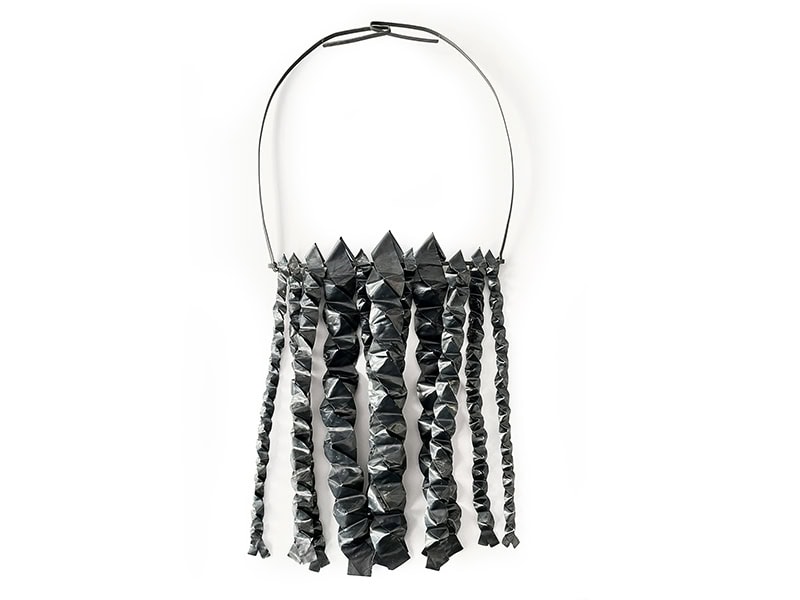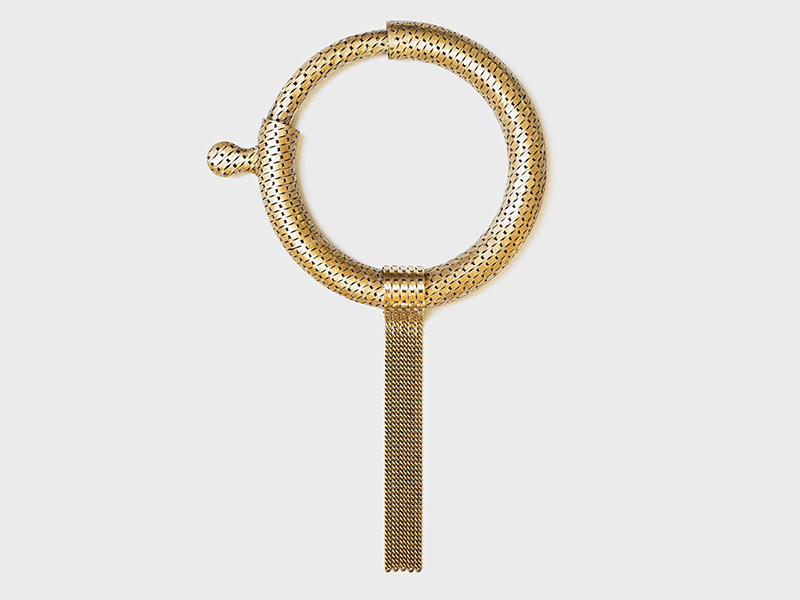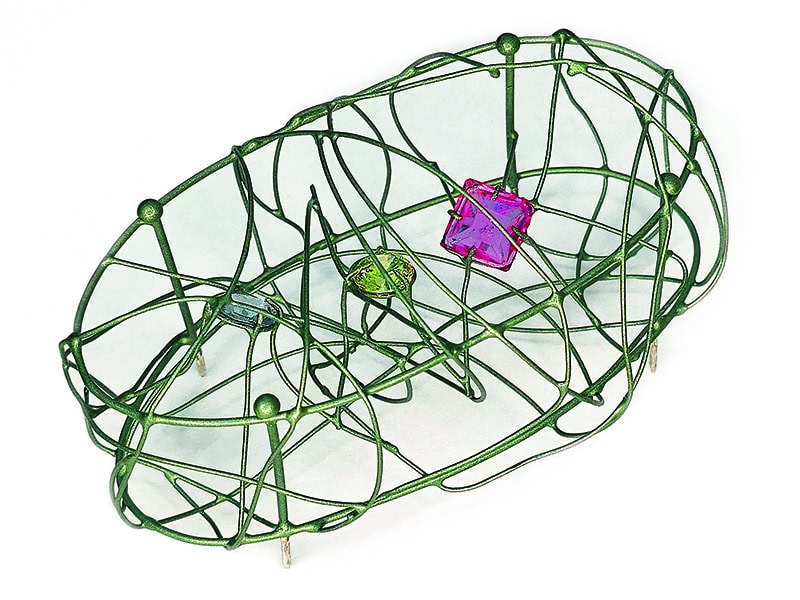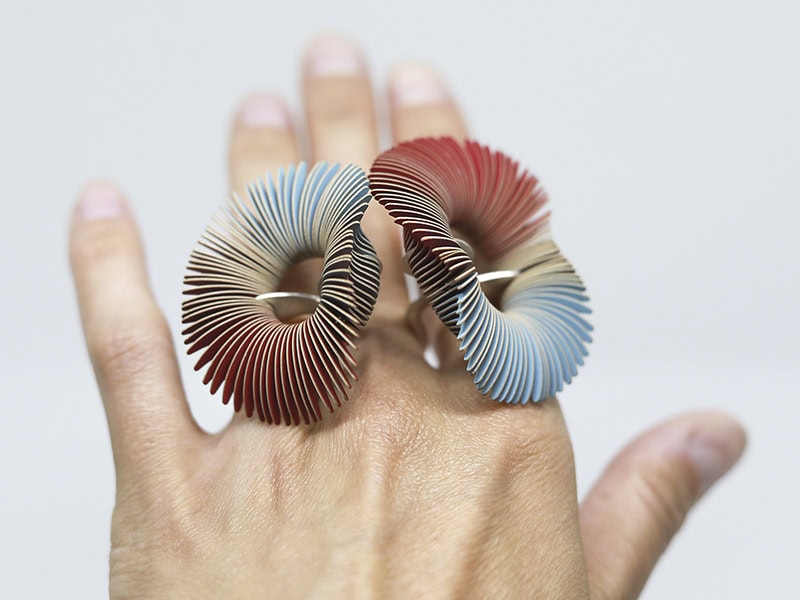
This section serves as repository for articles and reprints covering a variety of topics and perspectives related to the field. As part of our Education Program we commission curators, educators and art commentators to write articles that provide criticism, insight and perspective. These articles are published in the EDUCATION section of our site, to access these articles click here.
Individuals have as many reasons to buy and/or collect objects as there are objects available. Jewelry is one of the more personal passions in collecting due to its connection to our bodies. After all, most objects cannot be presented to the world on a daily basis in such an intimate manner as jewelry. We present a little of ourselves with each brooch or necklace worn.
Generally there comes a time in the lives of collectors to consider sharing pieces of our passion with the rest of the world through donations to museums and other institutions, thus promoting jewelry as an art form. This desire to give back is innate in most of us, even if we have varying secondary reasons attached to our giving. AJF is undertaking a project to provide a primer to inform interested collectors in navigating the process of donation. I have been asked to begin by providing some basic information that identifies the delights and pitfalls associated with the process.
In the spirit of full disclosure, I have not yet been successful in donating jewelry to an institution. I have, however, donated pieces from our contemporary ceramics collection to museums for the past five years. It has been extremely rewarding but I must tell you that I had been trying to donate work for ten years prior to our first success! This hints at why AJF wants to prepare you for and lead you through the forest. Believe it or not, it may be difficult to give your jewelry away! In celebration of your generosity, I present Life Lessons 101 for your desire to share.
Lesson One: critically assess your gift
The first step to success is to realize that there are many differences between personal collections and public collections. As in all aspects of life, there is never consensus. One size does not fit all, and a beautiful piece of jewelry that adorns your body so specially may have no place in the curatorial agendas of an institution. This is especially true for jewelry because one of the key components in the personal collection, the connection to the body, will never be duplicated in a museum setting. The extension of yourself that jewelry provides is not possible in an institutional exhibit. It is critical for you to gain the objectivity to look at your pieces with a museum’s eye. You can begin by looking critically at a museum’s collection, reading its curatorial statements, and by speaking to others who have been successful in lending or donating to the institution.
Lesson Two: do your homework
Once you believe that you have jewelry that might delight a curator or director of a museum, begin to research your options by looking at various public collections for a good fit. Is the museum focusing on historical jewelry and ‘light’ on contemporary examples? Is the institution wed to jewelry only from Western Europe? Is the museum strong in some areas of decorative arts, design or craft, but not so in jewelry? There are many more appropriate questions than these examples, but you must ask them and others to ensure the best repository for your donation in order to succeed.
Lesson Three: find the niche
Armed with your research, speak to others who might have experience with various institutions. This information can save you a lot of time and potential disappointment. Someone may know things from experience that you will not find in the museum’s printed material. Realize that most times there is more than one ideal home for your donations. Start with your first choice and proceed. It is imperative that you answer the questions related to why you have made your choice. Do you only want your pieces in a large, nationally known institution? Do you particularly want your gifts confined to a particular region? Close to home? Or does the idea of helping build a strong collection in an institution just starting to expand its jewelry holdings appeal to you?
Lesson Four: make a connection
Once you have made your decision, contact the institution. You might start with a letter or e-mail of introduction to the appropriate curator or director. Share you passion and desire to enhance the museum’s jewelry collection. Tell them of your collection’s focus and tease them with images if possible. Make it clear that you are looking to gift to the museum, unless you have other intentions. Ask for a face-to-face meeting at their convenience. Or invite them to see the work in your home. In short, convince them of your desire to donate and tell them why you have chosen to approach them in order to gauge their interest.
Lesson Five: be prepared
You know what they say about first impressions! Do not let yourself fall into the mind trap that a curator will gush about your intentions upon meeting you. After all, curators and directors are the stewards of the collection and they have seen a lot of work. Do expect courtesy and integrity and you won’t be disappointed. Even if your work is not felt to enhance a particular collection, a sensitive curator might lead you to another institution with a better fit.
Try not to have unrealistic expectations. The days of museums acquiring an entire collection are numbered. Try not to present an all-or-none condition for your gifts. Today this may amount to the kiss of death. If you are sincere about a gift to a particular museum, play by their rules and limitations. The result just might be the placement of one or more of your pieces in the collection of your choosing.
Feel free to express your desires about your pieces. If having the work on exhibit is your primary goal, you must discuss this with the museum. Smaller museums may be able to accommodate this request better than the large museum. If you simply want to add to the institution’s collections without stipulations, you may be more successful in more venues.
Expect conditions for accepting the gift from the museum as well. An institution may ask for a monetary gift to maintain the collection or for support for the institution at large. I have known at least one museum that made a financial gift a condition for accepting the work. Let nothing surprise you.
Lesson Six: finally . . .
Your work is not finished with the acceptance of the gift. Most institutions insist that the donor obtain an appraisal of fair market value. Rarely, a museum will undertake or share this requirement, so discuss by all means. Certified Appraisers for contemporary art jewelry are few. AJF plans to provide a list to its members in a future newsletter. Appraisers may ask for a percentage of the fair market value as their fee, may give you a flat fee, or may negotiate other arrangements depending on several factors including number of works to be appraised, ease of finding secondary market data, or having to establish a comparative value based upon like work. Again, discuss your options. Please realize that the IRS has put the onus on the appraiser if there is any question concerning the legitimacy of the fair market value appraisal. An appraisal therefore becomes a significant legal document.
The appraiser may ask for a copy of the institution’s Deed of Gift of your donation as well as a letter of acceptance of the gift from the institution. The appraiser also will expect you to provide the following information: title, date, artist, dimensions, mediums, provenance, how purchased, price paid, exhibition/publication history, and whether the piece is unique or part of an edition. The IRS requires most of this information as well. There are tax benefits associated with gifts to non-profits, but specifics will need to be addressed by your accountant or tax filer depending on your tax liability.
After all the T’s have been crossed and the I’s dotted, the jewelry you have treasured will become part of a greater whole. It will now belong to all of us for our education and enjoyment. There is a great sense of accomplishment and pride associated with being able to share one’s good fortune with others. Although the process can be daunting at times the rewards are great. Sharing your jewelry with new eyes fosters better understanding and appreciation of the field we have chosen to love. By all means be generous. What better way to give a part of yourself to posterity?
PHOTOS
Brooch, Robin Kranitzky and Kim Ovwerstreet
Ron Porter, AJF member and author of this article
I recently completed the Graduate Program in Fine Arts at the California College of the Arts in San Francisco. Submitting my portfolio to the Jewelry/Metal Arts Department, I was accepted into the program by the Program Chair, Marilyn da Silva with the approval of the Graduate Admissions Committee. I chose to attend CCA because of its enthusiasm for cross-disciplinary exploration and its emphasis on a greater awareness of the global context of contemporary art. Rooted in critically engaged studio practice, the program explores both the specifics of particular disciplines and the points of interaction and overlap among disciplines.
During my two years at CCA, I worked in close contact with my peers whose skill sets comprised ceramics, furniture, glass, jewelry/metal arts, textiles, media arts, painting/drawing, photography, printmaking, sculpture and social practice. This interdisciplinary aspect to the program resulted in an absence of jewelry within my MFA show. Given total freedom of expression, I made a conscious decision to let my concepts lead me to my methods of making, even if it lead me away from what I was familiar with. There is no doubt however, that my background as a jeweler informed my work at CCA. Five months after completing the program I am coming to terms with my experience and what it has meant to my artistic practice.
CCA’s graduate program is housed on the San Francisco campus and is comprised of two areas of study, studio practice and academic seminars. While engaged in their studio practice, students create artwork and receive feedback from faculty. This is supplemented with courses in the history of contemporary art aimed at providing grounding in critical theory. The Jewelry/Metal Arts Department, housed on the Oakland campus, is geared toward undergraduate study. While at CCA I came to the conclusion that the two campuses, and in relation, the two programs I was affiliated with, were very much separate entities.
I recall one of the first papers assigned in my Contemporary Art History and Theory Seminar in which I was faced with the task of placing my practice within contemporary critical concepts. Required to compare my work to three artists or movements covered in the curriculum, I chose Rosemarie Trockel, Guy Debord and the Arte Povera Movement. Unable to pull from the craft history I was familiar with because it was not included in the course, I quickly became aware of the new dialogue in which I was engaged. Studio critiques with faculty members worked as extended dialogues to the academic content of seminars. Similar to seminars, the field of Art Jewelry was not a part of the conversation. In critiques where I presented jewelry to my review panel I received responses such as, “Why not industrial design?” or “This belongs in the museum store, not the museum.” These comments communicated the sentiment that jewelry was unfamiliar as fine art. Its functionality and peculiar position between art, design, craft and fashion did not easily fit into the fine art dialogue.
For a period of time, I put my Art Jewelry books on the shelf. No one knew who Myra Mimlitsch-Gray or Ted Noten was. Therefore, referencing these artists in my critiques and studio practice meetings only confused things and made communication difficult. It also underlined the fact that these artists were not on the radar of my peers and instructors in San Francisco. They were craft, and specifically jewelry and metal work, which was a different dialogue. To begin building a foundation that would allow me to address my craft sentiment within the contemporary critical dialogue, I explored artists like Josiah McElheney, Anne Wilson, Cornelia Parker, Claudia Tennyson, and Grayson Perry who were not exclusive to craft but undeniably related.
While the more traditional studio craft was not part of the graduate program curriculum, there was a great deal of activity surrounding craft-related practices such as “DIY” and “Subversive Craft”. In February of 2008 the College Art Association hosted a conference in Dallas, Texas. One of its lectures entitled, Gestures of Resistance: Craft, Performance and the Politics of Slowness, pointed to an emphasis on the use of craft in contemporary art, “use” being the operative word. It seemed to me that craft was being revisited within contemporary art as an action where the object made is not revered for its craftsmanship but exists as documentation of the physical act of crafting.
I could not divorce myself from a reverence for craftsmanship; however, while at CCA I decided to ask myself the question, “Does it make sense to actualize all of my ideas in a jewelry format?” For the time being, I took on the mind-set of a fine artist invested in concepts of craft. My jewelry skills became part of my arsenal of art-making tools rather than techniques that defined me as a jeweler exclusively. I had to think about why I made jewelry and use that information as a guideline to build a new practice, which I thought of as an extension of my jewelry practice. I considered both to be equal and related but allowed to function independently.
These past five months following my graduation I have been trying to figure out my stance. The urge to make sense of the validity of jewelry making as a fine art practice and fine arts suspicion of it is always present. Laboring for a tidy conclusion is quickly becoming tedious and boring. For now I’m living within, understanding the in-between and asking questions about both. Nobody gets off the hook, everyone is valid. Recently, I re-read Gert Staal and Ted Noten’s manifesto, In Celebration of the Street, in the vol 27 no 5 issue of Metalsmith magazine. It struck me that without the institution of art, jewelry making is a powerful craft in itself. Making the objects that serve as dialectic units, jewelers create symbols that lubricate the rituals that comprise everyday human life. So here are the new questions I’ve been asking myself: Does that die when you take it away from the everyday sphere and elevate it to the museum or gallery? Or does it perhaps serve to highlight this unique function of jewelry?
*Click to view my thesis to see the culmination of my graduate experience.
A chance meeting with Bob Ebendorf at Penland and my penchant for his work has led to an on-going pen-pal relationship. It has been amazing to me that such a casual relationship could grow into a satisfying friendship based upon spirited discussions of the scope of contemporary jewelry.
So it was with a mix of expectation and trepidation that we accepted an invitation to visit him at East Carolina University, meet his fellow faculty and students and see his most recent exhibition at the Imperial Centre in Rocky Mount, NC.
We arrived Friday in time to attend an exhibit of mixed media jewelry by BFA candidate Callie Huskins. She created mixed media pieces of wax, paper, enamel and pearls. Allof the Metals faculty was in attendance and we were treated to a tour of the metals studios and a sneak preview of work by MFA Candidates, Daniel DiCaprio and Shand Stamper, and MFA graduate Marion Sak. Dan creates intimate, beautifully carved work from rare woods, gold and silver. Shand’s enamel pieces are informed by her experience with Hurricane Katrina, and Marion has created a body of beautifully crafted hollowware.
Dinner and jewelry conversation with School of Arts and Design Chair Linda Darty, and Bob capped the evening. Linda had just been awarded the ECU Faculty Lifetime Achievement Award for Excellence in Research and Creative Activity, so we were able to join in celebrating her achievements.
Saturday brought the short drive to Rocky Mount to see “Past and Present: a Continual Journey” at the Imperial Centre for the Arts and Sciences. The Centre is a beautifully restored and redesigned tobacco warehouse. Bob’s exhibition was shown in two of their spacious minimalist galleries. Although not arranged chronologically, the eighty brooches, necklaces and objects represented the full spectrum of Ebendorf’s mature work. All were from his private collection, so well-documented extraordinary work lay alongside rarely seen examples representative of fifty years’ of jewelry making. It was truly a treat for the jewelry lover. The exhibit is to continue to May 17, 2009.
A visit to the other gallery spaces in the Centre treated us to a juried show of Carolina crafts, a one-person show of sculpture, and one of painting.
Dinner with ECU metals faculty and MFA students at the home of assistant professor Tim Lazure completed our art jewelry weekend. The weekend was filled with all things jewelry, a delicious treat for any AJF member. The ECU metals facilities are state-of-the-art, and if the student work we experienced is any indication, the educational experience at ECU is rich indeed. We were impressed with the quality, craftsmanship, and unique vision of each student’s work. Importantly, none of the student work was a simple tweak of jewelry by their professors.
My pen-pal relationship with Bob has now grown because of this visit. Bob has just been asked to extend his tenure as Belk Distinguished Professor for another five years. I look forward to what those five years will add to his body of work and to art jewelry scholarship.
There are as many definitions of a collection as there are collectors. When noted art collector and philanthropist Eugene Thaw was asked how he would define the art of collecting, he answered with this beautiful explanation: “It’s about making some sense out of a group (large or small) of related objects that you’ve accumulated and having each one reinforce the others. You should always be reaching for better examples than what you have, and you should find out what you’re missing, too, so you can fill in the blank spaces. It’s an intellectual activity. I collect to learn and when I feel I have learned my way around a field enough to have a well-rounded collection I give it away — to museums. I no longer need to physically possess works of art, I have them in my mind’s eye."
The universal truth seems to be that collectors complement their passion with intelligence to build a meaningful collection. Here are suggestions that may prove helpful as you build your collection: Visit as many galleries as you can, gallery owners can be helpful guides.
Join local art museums and introduce yourself to curators. Share your collecting interests with them. AJF offers opportunities to talk to other collectors and find out what they know and have learned about collecting.
Read! Read anything you can find that relates to your collecting interests - art, art history, reviews and trade publications.
Discovering how objects came into the museum is an interesting aspect of any exhibition — some donated, others loaned, some given as a bequest or purchased with donated funds. Collectors and curators need each other, collectors for the work a museum desires and curators for bringing the work to the museum. For both the museum and donor there may be tax and legal considerations, for these reasons most museums offer highly personalized, full service consulting resources for all types of charitable giving.
Private collectors are often asked to lend their art for exhibitions. By giving the work public visibility you support the museum and the artist. Additionally, loaning may have the added benefit of enhancing the value of an object through public visibility. There are a number of considerations to take into account when loaning a piece to a museum including: value, term of the loan, insurance and liability, transportation and packing, photographic rights, exhibition and labeling and security. These and other considerations are articulated in a loan agreement document signed by both the lender and the museum. It is important to have photographs of the item and documentation that supports your purchase. Your insurance agent is a valuable resource should you have questions.
Assuming your heirs are not keeping their fingers crossed in hopes that your beloved art jewelry will some day be theirs, then you may want to consider making a gift of your jewelry. Gifts are of great benefit to museums, universities and non-profit organizations. Gifts have been responsible for the growth and enhancement of many permanent collections.
Gifts can be wonderfully simple, flexible and easy to make. There are many benefits of making a gift of art either during your lifetime or by bequest. You guarantee that your treasured piece will be cared for to the highest standards. You gain a charitable deduction for tax purposes and the removal of items subject to estate tax on the value of those objects. Through your gift, the artist is celebrated and the art form is preserved and displayed for the scholarship and enjoyment of generations to come. If you are considering making a gift, explore all the potential recipients, consider all the options, weigh the tax considerations and most importantly enjoy the process of giving. Once you have found the best place for your pieces you should document your intent to give. Museums can provide appropriate language for updating your will or assist you in documenting a current gift to the museum.
PHOTOS
Daganit Stern Shocken, brooch.
Keith Lewis, Heart Orgy, brooch, 2001. Sterling silver, 24k gold. Exhibition loan by Sally von Bargen to Fuller Craft Museum for the 2006 exhibition The Edges of Grace: Provocative, Uncommon Craft.
Kiff Slemmons, Wrist Flick II, Bracelet, 1999. Sterling silver, photographs, mica. Mint Museum purchase, funds provided by Sharon and Craig Campbell.