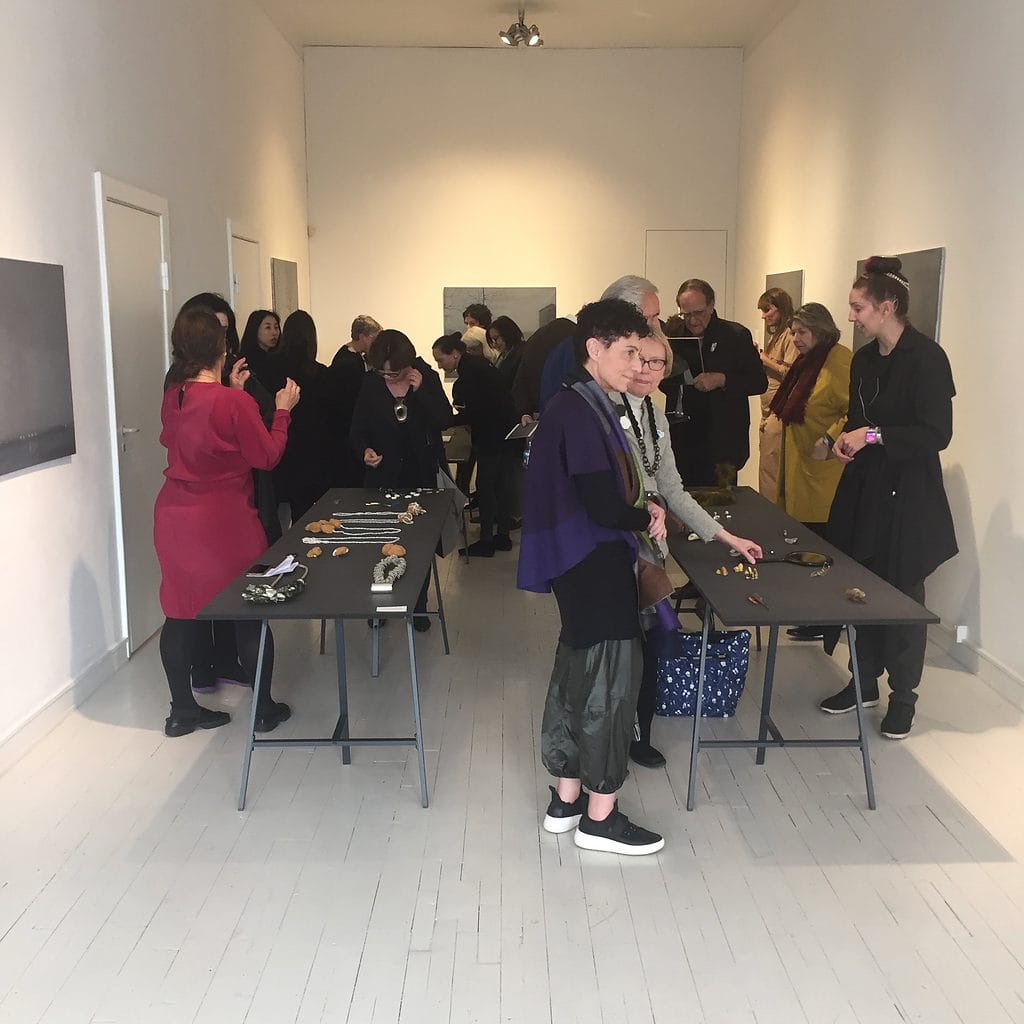
Heirlooms are, by definition, are objects, property or cultivars that are passed from one generation to the next. This gives us a perfunctory understanding of what an heirloom is—it does not, however, convey the emotional potential of certain objects, places, or ideas (stories, techniques, or perhaps even, traditions) that could all be heirlooms in one sense or another. One of the difficulties in talking about heirlooms is that they are often associated with emotion and memory—qualities that change with time and as the “property” is passed along and that are often derided as sentimental or nostalgic. This complex connection to the emotional, personal or sentimental can also be an important element of jewelry. When the two meet—heirloom as a concept and jewelry—the results are intensely engaging.
The recent work of contemporary art jewelers such as Brigitte Adolph, Melanie Bilenker, Lola Brooks, Gesine Hackenberg, Anna Lorich, Mary Pearse, Monika Strasser and Renee Zettle-Sterling underscores the link, inherited or not, between past and present and establishes a framework for investigating the role of jewelry as a conveyor of personal, social and cultural meaning.** This essay identifies only a few of the contemporary art jewelers who are engaging with the past, their past. Rather than offer a definitive answer as to why there is a trend to make jewelry that explores the world in this way, I attempt to draw attention to some of those making significant work in this direction and encourage further contemplation of both the artists themselves and the larger idea as a whole.
“My historical reference points are perhaps oxymoronic; the death obsessed and sentimental Victorians and the optimistic creative vigor and largesse of 20th century costume jewels.”
-Lola Brooks, 2008
As Lola Brooks’ quote underscores, the Victorian era (1837-1901) set a tone for imbuing objects with personal meaning that remains attractive today. Many types of jewelry were fashionable but those that seem to most exemplify the period in a historical capacity are those that embody a certain type of romanticism—namely, hair and mourning jewelry, inscribed engagement rings and jewelry made with jet (the black gemstone that was popular for its beauty and worn for fashion as well as mourning).
With an overabundance of so-called sentimental icons such as vintage ivory roses, champagne-cut diamonds and stainless steel bows in her latest brooches and neckpieces, Brooks challenges the idea that certain “signifiers” can no longer hold any real meaning and reworks the vocabulary to offer pieces that are a celebration of material and content, no longer “saccharine clichés of beauty, sentiment, perfection and the feminine.”
Melanie Bilenker draws on the intimacy evoked with hair jewelry by memorializing her personal private moments—“snapshot” scenes of daily life such as cooking at a stove, relaxing in a bath or portraits of hands and feet—out of her own hair.
Mary Pearse’s recent brooches of plastic, steel, silver and precious stones have primarily been compositions in white—ruminations on the idea of loss and odes to Victorian jewelry that marked the passage of time and served as “memorials” to loved ones.
While not specifically addressing personal family connections, Brooks, Bilenker and Pearse engage with subject matter that is linked to the idea of things personal—part of this extends from the fact that they create jewelry meant to be kept close, worn on the body, yet this is not the only connection. They turn intangible memories, bonds and emotions into tangible objects—further linking an intimate object with intimate ideas.
Simultaneously, jewelers such as Brigitte Adolph and Anna Lorich are tackling the potentially raw and sticky subject matter of their families. Adolph and Lorich refer specifically to their families as inspiration but they also represent a larger segment of contemporary practice that is reinvigorating (perhaps a better term is re-appreciating) historical textile techniques within jewelry, interior design and sculpture and installation. Their use of such techniques and methods metaphorically links them to their bloodline family but also connects them to so many others who recognize the value of such practices and the way they can immediately both reference (perhaps nostalgically or sentimentally) the past and establish connections between people.
Long interested in antique lace and embroidery, Brigitte Adolph transforms family heirlooms of lace and stitching into gold and silver “lace” jewels. Visually deceptive, her earrings and necklaces look like fragments of lace in thread but are of silver and white and yellow gold—they are brand new objects that keep her connected to her past, that evoke personal memories of her home and that offer the same personal “potential” to many a wearer or viewer. Anna Lorich uses family images and objects as source material for intensely embroidered rings, sweetly stitched portrait brooches and narrative drawings. She bluntly states that her jewelry is about feelings and that she plays with “notions of a family narrative, tradition, generation and ancestry.”
Considering the jewelry of Adolph and Lorich also takes us quickly to ideas of the domestic—the connection to textile handcraft in their work as well as the intimacy evoked suggests private contemplations in domestic spaces. The “domestic” conversation is a multilayered one that seems to be constantly in flux—tied to ideas about certain kinds of objects, conceptions of gender and notions of comfort, the decorative, the sentimental and the familiar. Interested in how “both the home and the objects in it retain enormous memorial weight,” Renee Zettle-Sterling creates brooches of vintage fabrics, beading and silver for her Objects of Sentiment series. She replaces gemstones with materials of different value—historical, cultural and personal. Soft and sweet, her pieces are simultaneously familiar and unfamiliar—with stitching and little beads and things we would like to keep close but reconstructed in a way that makes them seem a little alien.
Monika Strasser’s series of Schattenbroschen (Shadow-Brooches) are made of the handles of cutlery (inherited from her family) and she presents them in, in her own words, “nostalgic looking baroque cases” that contain stitched shadows. While they formally approach connections to the sentimental in a very different way than Lorich or Adolph, they are steeped in family memory—as Strasser states, “You can’t run away from your family history, just as you can’t shake off your shadow either.”
And, Gesine Hackenberg examines the meaning of objects by creating necklaces with beads of porcelain cut from decorative dinner plates. The preciousness of Hackenberg’s jewelry is tied not only to the fragile material of the dinnerware beads but also to their ability to embody emotional as well as material value—as Hackenberg herself suggests, “Objects of use often become intimately precious and indispensable to us, as it happens sometimes to a piece of jewellery [sic] that we wear day in, day out.”
Rather than seeing sentiment or nostalgia as content to be avoided, these jewelers represent an embrace of the past and a willingness to challenge and explore meaning complicated by the idea of personal history and emotion. They are a few of those extending their investigations of jewelry in this decoration—a pursuit full of potential. Even though this contemporary jewelry is echoing, reconfiguring or recontextualizing history, it does not ring false or forced—the element of the human condition that gives this work so rich a framework is a connection that links the intimate to the public, the personal to the cultural.
**Often, these endeavors include, sometimes more implicitly than explicitly, a re-consideration of ornament both in form and content. This exploration of decorative elements as linked to society and culture is happening across media. Even within contemporary art jewelry, there are multiple paths of investigation concerning history and ornament. Those mentioned in this article implicitly address ornament while others, such as Anya Kivarkis, Uli Rapp, Constanze Schreiber and Emiko Oye, represent those explicitly exploring the links between historical forms of jewelry, luxury, social status and wealth. For more information on this particular avenue of investigation, see the forthcoming Metalsmith article “Mining History: Ornamentalism Revisited,” that I co-authored with Namita Gupta Wiggers.
Lena Vigna, currently Curator of Exhibitions at the Miami University Art Museum, Oxford, Ohio, is drawn to adornment in all of its forms. Recent areas of exploration include political garments and accessories, jewelry that reconsiders the past in the present, contemporary chandeliers, notions of utopia, extreme yet wearable garments and lace. Lena was awarded a 2006 Craft Research Fund Project Grant from the Center for Craft, Creativity, and Design, University of North Carolina, for scholarship related to the exhibition and upcoming publication Laced with History (curated while she was Curator of Exhibitions/Department Head at the John Michael Kohler Arts Center, Sheboygan, WI, and featuring works by artists who use or reference lace in their work as well as objects by historical and contemporary lace makers.)
Images
Melanie Bilenker, Saturday (brooch), 2008, Gold, ebony, resin, pigment and hair, 2 1/8 x 1 ½ x 3/8 in., Courtesy, Sienna Gallery
Gesine Hackenberg, Kitchen Necklace, Makkum Vogel plate and polyamide thread, Courtesy, Sienna Gallery
Lola Brooks, Brooch, 18kt gold, stainless steel, vintage ivory roses and rose-cut champagne diamonds, 4 ½ x 4 ½ x 1 ½ in., Courtesy, Sienna Gallery

Several artists including Gabrielle Fitzgibbon, Yong Joo Kim, Jessica Stephens, Seth Papac and Laura Prieto-Velasco make modest materials the subject of their work. Fitzgibbon, Kim and Stephens transform ordinary plastic and foam to create refined pieces of jewelry. Each artist elevates and transforms their material, from everyday to jewel-like. In Fitzgibbon’s necklace, finely cut sheets of mylar glisten like mica; black drinking straws in Kim’s necklace are repackaged as precious bundles of onyx; and Stephens sets like stones colored craft foam, amidst brightly enamel-painted copper. Seth Papac and Laura Prieto-Velasco seem less interested in concealing the humbleness of their materials. Papac plays with the aristocratic origins of parures, but where historic parures might feature gems and fine metalwork, Papac’s parures incorporate obvious bits of trash including deflated balloons, plastic bag scraps, and discarded luggage tags. Prieto-Velasco’s brooches combine strategies found in both Papac’s and Kim’s work. Her carpet tacks and scraps of tape are held together with silver and iron wire to create elegant, gestural forms.
Nathan Dube, Burcu Büyükünal, Sarah Troper and Lauren Vanessa Tickle take a more humorous approach towards their objects. Typically, kids improvise spitball shooters from straws and paper wads, but Dube fabricates elaborate versions of the delinquent’s trade complete with gun site, targets and multiple spitball chambers. Büyükünal’s piece, Redetermined destiny, is more menacing than Dube’s playful spitball weapons. The crisply designed palmistry kit includes jigs that fit over one’s hand and knives intended to recut the lines on one’s palm, ostensibly to create a more desirable future. Troper commemorates the remnants of a carnival by remaking paper tickets and party hats out of steel. Crumpled and creased, the metal hats and tickets freeze in time the aftermath of a party. Tickle makes overt the value of jewelry by employing paper money in lieu of precious metal and gems.
however, each ornament depicts the mouths and teeth of rats, mice and squirrels, animals that one might find hidden in the walls of a dilapidated house. Her title, Gnaw, suggests that these creatures might in fact be trying to pry themselves out of the walls and into human space. Polak convincingly replicates animal hooves, hide, and fur in her amulets. She explores the long tradition of infusing animal parts, from rabbit feet to eagle feathers, with ritual significance.
artist like Cornelia Parker often comes to mind. She has steamrolled elegant silver tableware, crushed French horns and trombones, cut and reassembled gold wedding rings, and drawn into fine wire teaspoons and coins that measure the immeasurable. Actually, she hasn't done anything to these objects. Rather she has hired others, skilled laborers and craftsmen to execute her ideas. As I visited this exhibition I couldn't help but think of Cornelia Parker, an artist who reveres craft, but only as a means to its unmaking. Conversely, the work in to be: (determined) presents emerging artists who have honed their craft, honoring the history of their materials and the esoteric knowledge necessary to produce the range of objects on display. Where an artist like Cornelia Parker subverts the history of craft through grand gestures of destruction, the artists in to be: (determined) subvert the history of metalsmithing through their use of quotidian materials and their representation of seemingly inconsequential actions, all the while maintaining a dedication to their discipline.
Organized in four parts the show mirrors the four collections which comprise the Chi ha paura…? jewelry line. The core collection on view was originally launched in April of 1997 and is comprised of 22 pieces including such iconic works as the Circle in Circle bracelet designed by Gijs Bakker in 1967 and the Broken Lines ring designed by Emmy van Leersum in 1982. These early works are the exception and the majority of the core collection represents pieces specifically designed for the label by such highly respected members of the jewelry and design fields as Marc Newsom, Ron Arad, Otto Kunzli, and Ruudt Peters.
pieces do provide a strong foundation, adding such prestige that only work that has stood the test of time can offer. Gijs Bakker’s Little Finger (1967) and Rolf Sachs’s Strip (1995) are compelling examples of the clever restraint, which has become a benchmark for Dutch jewelry. Design however, is similar to fashion and operates to some extent in cycles. These cycles run their course, making room for the new and pushing out the old. While certain ‘timeless’ pieces retain their luster, some designs can appear stale and out-dated among newer innovations. While this show contains many iconic pieces, bringing to the viewers attention the contribution this label has brought to the field of contemporary art jewelry, others works like Esther Knobel’s Rose (1997) and Hannes Wettstein’s Triller (1997) appear today as irrelevant and awkward.
How effective has the label been at its goal of creating conceptually rigorous pieces that serve to elevate jewelry as an intelligent means of design on par the with rest of the design world? Some evidence of the lines acceptance into the design world may be gathered from the designers themselves. Interestingly, when visiting Marc Newsome’s website I found no mention of Chi ha paura…?, though it includes mentions of clothing design for G-star and his own line of watches. On the other hand artists such as Tjep, who’s Bling Bling won a Dutch Design Award in the category of fashion design in 2004, have fully incorporated their pieces for Chi ha paura…? into their website.
PHOTOS (top to bottom)
Marc Monzo
So this is historical reconstruction, but something more than faking old treasures, because presumably the jewelry was treasured as important contemporary objects and worn to make contemporary political and cultural statements. We are talking about the 1870s-1890s here, so how did this movement fit into prevailing cultural forms of the time – the National Romantic style, for example, that localized Art Nouveau? The jewelry itself is strange. Made of precious materials such as gold, pearls and diamonds, it is ornate, overworked and kind of primitive at the same time – a fancy Victorian version of ancient objects. Mellin’s jewelry is joined in these cases by a number of other jewellers working in the nineteenth century, demonstrating that the movement that Mellin best represents remained alive for a long period – from the 1840s to the 1890s.
are a series of portraits in oil on canvas, depicting women wearing jewelry. These also have no introduction, although when you realize that archaeological jewelry – rather than jewelry in the archaeological style – is on display, you begin to understand why the paintings are here. (They demonstrate jewelry in action, the context of fashion and the wearing of jewelry in earlier times.)
The gallery on the left side of the foyer also deals with another instance of jewelry reconstruction. According to the wall text, ‘The Association of Kalevala Women, founded in 1935 in honour of the centennary of the publication of the Kalevala folk poetry epic, launched a project for a statue of Louhi, a leading female character of the Kalevala. Replicas of archaeological jewellery and ornaments began to be made for sale to fund the project. The artist Germund Paaer was hired to prepare the designs. At first, Paaer drew designs based on forty prehistoric brooches and ornaments in the collection of the National Museum of Finland, but the great demand for the pieces soon led to an addition of thirty-four items to the product range. Paaer later designed his own jewellery in the spirit of the archaeological material. The first models were made by the Hakkarainen fine metalworking firm and in silver by Pertti Helski of Lahti and K. Kaksonen jewellers of Helsinki. The Kalevala Koru (Kalevala jewellery) company was established in 1941.’
This is a very nice contrast with the gallery showing the archaeological style across the foyer. This twentieth century revival is of a different order, and must have more of a relationship to modernism, not to mention very different resonances in terms of national identity projects. It seems to me that this is a very smart way to approach the past in this exhibition. Apart from the obvious logistical possibilities – it is easier to get nineteenth and twentieth century 'copies' than the old objects themselves – it really puts into play a series of questions and disruptions in terms of how the past is experienced and reproduced in the present. Through the introduction of these two galleries, we are made aware of how active this process is, how much any contact with the past is a kind of fabrication shaped by the present's particular concerns.
The next gallery is called 'The heirs of St Petersburg', and the wall text notes that ‘From 1809 onwards, when Finland became a Grand Duchy of the Russian Empire, it became natural for large numbers of Finnish apprentices and journeymen to seek opportunities and sources of inspiration in St. Petersburg, the growing and dynamic capital of Russia. The imperial city, where the arts of goldsmithing and jewellery-making thrived, offered excellent career opportunities to Finnish craftsmen, who were in demand because of their careful work and reliability. After the Russian Revolution of 1917, hundreds of Finnish craftsmen returned to their homeland. One such returnee who had great influence on arts and crafts in Finland was Oskar Pihl, the nephew of master craftsman Albert Holmstrom of the Faberge jewellery firm. Pihl had been taught jewellery design by his circle and had been apprenticed to the family firm. In Finland he came to work for Alexander Tillander, who had also fled the revolution and had established a company in Helsinki. This meant that the tradition and high-standard of work at St. Petersburg continued well into the 20th century in Finland, although most of the world was unaware of it.’
The largest gallery in the exhibition has no introductory wall text at all, even though it is clearly the heart of the show. Instead, we are given biographies of the various jewellers whose work is on display. The birth (and sometimes death dates) of these jewellers indicate that this must be the Finnish modernist section of the exhibition. Again, without any explanation the very first displays are of jewelry from the early twentieth century, which appears to share some folk or primitive references with the Kalevala display in an earlier gallery. But if this is the intention, we are kept in the dark about it. (And how do the earlier movements relate to this central part of the show? Or, to ask that another way, where does Finnish modernism come from?)
sense of what Finnish modernism was actually like as a movement, and to consider individual differences within it, the accents of personal style. It is fascinating how precious stones, or indeed non-precious stones, can inflect Finnish modernism in quite different ways, or how individuals can create a sense of complexity or an impression of the ornate that strains the limits of the movement, all the time using the same vocabulary of geometric units, unadorned surfaces, bold sculptural forms. And how interesting that this movement produced good work for such a long period of time, spanning the late 1940s until the late 1970s.
The exhibition finishes with two galleries of contemporary jewelry. On the right is a display from the collection of Helena and Lars Pahlman. The wall text notes that ‘Helena and Lars Pahlman began to collect art and jewellery in the 1970s. Their jewellery collection has now grown to more than 1000 items. For the Finnish Jewellery exhibition, they selected from their collection 100 pieces dating from the 1970s to the present day. Representing in their selection are designers from Finland, Scandinavia, the Baltic countries, and the rest of Europe, Israel, Australia and the United States. A distinct group consists of jewellery by Finnish visual artists and designers from outside the jewellery design sector.’


In San Francisco I’m given the catalogue Beyond the Obvious: Rethinking Jewelry, which features the work of Jamie Bennett, Lisa Gralnick, Keith Lewis, Bruce Metcalf, Sondra Sherman and Kiff Slemmons. Looking at it proves beyond doubt that American jewellery is good quality – serious, committed, with a developed language. (I don’t always understand this language, but exposure to new things is why I’m travelling.)
Similarly, with Peter Hoogeboom’s work, the dynamic is so different to home, where borrowing motifs or the style from indigenous jewellery would be called cultural appropriation, a kind of theft. When I asked Peter if anyone had ever accused him of cultural appropriation, he said, who would say that to me? Just then I saw the huge difference between his world and mine. At the centre of empire, where objects have flowed from the colonies for centuries, there is no one to challenge what you do. In a colony like New Zealand, the native people will hold you to account.