
Marzee
Damian Skinner, ed., foreword by Petra Hölscher, texts by Susan Cummins, Flos Wildschut, and Lizzie Atkins

Overview
The name Marzee refers to intertwined identities. There is Marie-José van den Hout (known as Marzee), the dealer whose drive and passion makes everything possible. There is Galerie Marzee, the institution with a rich backstory, a fabulous building, and enviable programs. And there is the Marzee Collection, more than 2,500 objects that track the history of Marzee the individual and Marzee the gallery. This book tells the story of the dealer, the gallery, and the collection. In 1978 Marie-José opened the first Galerie Marzee in an old butcher’s shop in Nijmegen, the Netherlands; today the gallery occupies an impressively renovated grain warehouse on the river Waal. Imbued with the powerful minimalism of the building, Marzee the book presents over 300 pieces from the Marzee Collection, chosen and arranged by Marie-José van den Hout herself.
Cost: $62.
- Price includes shipping for the US. Click "buy now" below.
- Delivering outside the USA? Email us for a shipping quote.
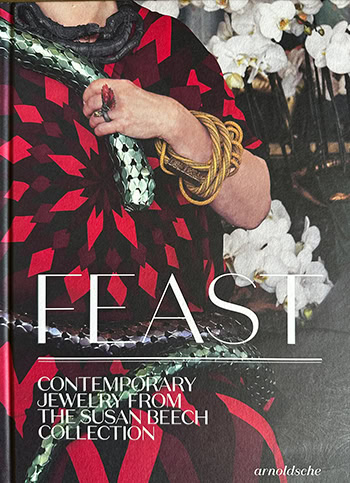
Overview
Welcome to a private tour of the home of American collector Susan Beech. Since 1991, Beech has been transforming her house in Tiburon, California, into an extraordinary environment, in which the themes of her extensive jewelry collection interact with craft and fine art, all against a backdrop of Art Deco glamour. Beauty is entwined with darker forces of death and decay, and glimpses of pleasure are complicated by a nod to the surreal and uncanny. The result is a wholly original and fascinating stage for a major collection of contemporary jewelry thoughtfully assembled over four decades.
Lavishly illustrated and featuring four essays exploring Beech’s activities as a collector and wearer as well as the key themes of her pieces, the publication Feast: Contemporary Jewelry from the Susan Beech Collection marks the donation of the collection to the Renwick Gallery, Smithsonian Museum of American Art, in Washington, DC, and the Museum of Arts and Design in New York City.
Cost: $75. SOLD OUT
North by Northwest: The Jewelry of Laurie Hall
By Susan Cummins and Damian Skinner

Overview
For more than four decades, Laurie Hall has been making stories the subject of her work. Her playful and funny jewelry beset with found objects is about the places she lives and the landscapes that fill her imagination, about her family history and different ideas of what it is to be an American.
As a jeweler, Hall never plays it safe, preferring to fly by the seat of her pants and push her skills and technical knowledge. She amuses herself and, in the process, amuses the wearer and viewer. She is a product of the jewelry histories that make the Pacific Northwest unique within the larger story of American contemporary jewelry. Featuring 58 images of Hall’s jewelry spanning the period from 1974 to 2019, this book explores why she is an important maker whose practice deserves to be more widely known. This is the story of Laurie Hall’s jewelry.
Cost: $45.
- US shipping: +$5. Click buy now below.
- Delivering outside the USA? Email us for a shipping quote.
Dead Souls: Desire and Memory in the Jewelry of Keith Lewis
By Damian Skinner

Overview
Since the late 1980s, American jeweler Keith Lewis (*1959) has been consistently tackling issues of Queer identity and politics in his figurative and narrative jewelry, including a groundbreaking series of memorial jewels addressing the impact of the AIDS crisis on himself and his community. Often witty, sometimes shocking, frequently erotic, and surprisingly moving, his jewelry is an act of remembering and witnessing, and a joyous assertion that desire and pleasure, wonderful ends in themselves, can collapse historical distance and connect the past and the present. Written by Damian Skinner and featuring four of Lewis’s artist talks documenting key preoccupations and series, this monograph surveys a bold, provocative, and ambitious body of work that deserves to be widely known.
Cost: $45.
- US shipping: +$5. Click buy now below.
- Delivering outside the USA? Email us for a shipping quote.
Best of Interviews
By Art Jewelry Forum, edited by Benjamin Lignel

Overview
We culled 18 provocative conversations with luminaries in the field from the interviews we have published with luminaries in this field since we began reporting more than 25 years ago. These interviews underscore the importance of art jewelry and its place on the contemporary jewelry spectrum.
Interviews: Dr. Madeleine Albright, Gijs Bakker, Jamie Bennett, Lola Brooks, Helen Drutt English, Iris Eichenberg, Clo Fleiss, Warwick Freeman, Matthew Friday & Kerianne Quick, Ursula Ilse-Neuman, Yevgeniya Kaganovitch, Sally Marsland, Myra Mimlitsch-Gray, Helena and Lasse Pahlman, Sienna Patti, Bruce Pepich, Lindsay Pollock, Dorothea Prühl, 2Roses, Tanel Veenre
Contributors: Rachel Carren, Gabriel Craig, Susan Cummins, Aaron Decker, Iris Eichenberg, Benedikt Fischer, Benjamin Lignel, Jillian Moore, Damian Skinner, and AJF members
Cost: $20.
- US shipping: +$5. Click buy now below .
- Delivering outside the USA? Email us for a shipping quote.
On and Off: Jewelry in the Wider Cultural Field
By Art Jewelry Forum

Overview
Contemporary jewelry is defined by its range of cultural references and willingness to tackle contentious issues.On and Off depicts this conversation between incorporated social norms and creative agendas, exploring the phenomena that inform and complicate jewelry’s history—sex, domination, self-identification, territory, death. In reporting on contemporary practice, the book examines jewelry’s provocative place in human affairs. Thirty short essays present jewelry in the wider cultural realm. About half focus on individual works, while the others engage with jewelry’s agency in the social, political, and private spheres. The collection invites some of the meatier topics to the jewelry table: cultural appropriation, social engineering, political propaganda, or jewelry-mediated empowerment.
Essays by: David Beytelmann, Nigel Borell, Monika Brugger, Cécile Bulté, Susan Cohn, Anna Conticello, Liesbeth den Besten, Rutger Emmelkamp, Julie Ewington, Mònica Gaspar, Stephen Knott, Marthe Le Van, Baptiste Lignel, Jillian Moore, Stephen Mulqueen, Elisabeth Murphy, Kevin Murray, Kerianne Quick, Suzanne Ramljak, Amina Rizwan, Damian Skinner, Emily Stoehrer, Timothy Information Limited, Namita Gupta Wiggers, and Marilyn Zapf
Cost: $20.
- US shipping: +$5. Click buy now below .
- Delivering outside the USA? Email us for a shipping quote.