This section serves as repository for articles and reprints covering a variety of topics and perspectives related to the field. As part of our Education Program we commission curators, educators and art commentators to write articles that provide criticism, insight and perspective. These articles are published in the EDUCATION section of our site, to access these articles click here.
A late night last October doesn’t feel so long ago. In the studio, burning the midnight oil, polishing off my online submission for Talente. At the time it felt like one of those lotteries – ‘gotta be in to win’. I had only recently realized I was actually eligible (you have to be 30 and under). Little did I imagine that five months later I’d be walking the snowy streets of Munich.
As an emerging jeweler, being selected for Talente is a tremendous encouragement and endorsement. It suggests someone somewhere thinks you might have an inkling of promise. So I was incredibly grateful for the opportunity, from Creative New Zealand, the national arts funding body, to attend the show in person and experience this jewelry pilgrimage. The week of events was one of exhilarating (and slightly dizzying) full jewelry immersion. Aside from Schmuck and Talente there was a multitude of satelite exhibitions, showcasing a work from many countries. As a result people had journeyed from all over Europe, the UK, USA, Australia and our six-strong contingent all the way from New Zealand.
Talente was naturally our first stop in the week of events. To provide a bit of background, Talente is organised annually alongside Schmuck by the Handwerkskammer für München und Oberbayern. Both are part of Munich’s International Trade Fair. Located at the outskirts of Munich, the trade fair occupies a sprawling former airport and includes everything from plumbingware to specialty sausage. Needless to say most of us never left Trade Hall A (the handcrafts hall).
Unlike Schmuck, Talente focuses on young and emerging talent from a range of craft and design fields. This includes jewelry (which always has a strong presence), ceramics, glass, furniture, lighting design, textiles, fashion, product design and technology. This year 99 entries were selected from the 400 submissions, representing 24 countries. The diversity of work in itself is impressive – from vessels, lamps and furniture, to a boat, a burial urn and almost everything in between. I would estimate close to half was jewelry.
Memorable examples included the hyper-realistic fake flower corsages of Jihye Lee (South Korea), the tack-a-rama fake nail and LED flower ensembles of Lisa Juen (Germany/China), the subtler stone and photograph assemblages of Berta Riera (Spain), and the lightweight realistic boulder brooches of Barbara Schrobenhauser (Germany). In truth, there was so much to see in Talente alone (not to mention the neighboring Schmuck, Exemplar and gallery shows) that it was a little overwhelming. Despite visiting three times, I was relieved to have the color catalogue to go back to at a later date.
With the week’s packed lineup, I was keen to see different approaches to exhibiting jewelry. In Talente and Schmuck, the challenge of displaying such variety understandably meant the exhibition design was fairly innocuous. The works were laid out in well-lit glass and steel cabinets, or hung from the steel partition system – tidy industrial design but more in the spirit of the trade show it was part of.
Many of the satellite exhibitions, however, were sited in more unusual locations or featured inventive displays. One of the most experimental shows was Eternal Shine – it’s not a Pony, by four current and former students at the Academy. This was a kaleidoscopic treat with mirror plexiglass display boxes hung on the grungy walls of a painting studio. These boxes were arranged at various heights that forced you on your our tippy-toes or demanded you squat down for a good look. Their entertaining optical effects certainly held people’s attention but, surprisingly, without detriment to the jewelry. Melanie Isverding’s enameled structures and Nicole Beck’s stitched body-part assemblages were particularly memorable. The mirrors were quite pragmatic, offering 360-degree view of the pieces, and, if anything, the ambient visual noise moved you in to focus on the pieces.

The overall jewelry highlight was Karl Fritsch’s revival of the Pinakothek der Moderne’s contemporary jewelry collection. (To read more about this exhibition, click here.) The collection itself was awe-inspiring – certainly a contemporary jewelry hall of fame – and I admired the fact that Fritsch curated this volume of work without resorting to museum conventions of logical groupings and labels. Arranging works into meandering lines in a seemingly random order, Fritsch successfully put the works into dialogue with one another (reflecting, I like to think, the vibrant diversity of the contemporary jewelry field). Rather than focusing on individual works, their close proximity drew attention to the connections between them. The lack of labels deemphasized who-made-what, though it was still fun to play a guessing game wrestling with the oversized list of works.
Other memorable shows included the Dialogue 8 show (UK) in an old foundry, spatialPalace (Estontia) in a cemetery, and the walls of shirts in Nicht dass du mir von der bluse fällst. Interestingly, the work I enjoyed most the often was part of more conventional displays.
Glancing back through my journal, I see I went to twenty-two exhibitions that week, and many of them twice. This meant I was shifted from my usual role of maker/wearer to the full-time role of jewelry viewer. On one level, seeing the jewelry in person (without the texts to dictate our response) permitted appreciation of craft for craft’s sake – enjoyment of the material and formal possibilities of jewelry. On another level, it made aware of the particular kinds of interaction a viewer has with jewelry. Within the tight schedule, many works were consumed at a glance while others stood out because they demanded prolonged attention. Pieces that commanded a second look, included Fabrizio Tridenti’s complex structures (in the Pinakothek der Moderne), Bettina Dittlmann’s intricate wire works (at Galerie Isabelle Hund and Danner-Rotunde) and Mirjam Hiller’s intriguing folded constructions (at Galerie Stühler). For me, these tended to be complex forms that resisted a quick glance. They somehow confused my eye, forcing me spend time, running over their surfaces and structures with a visual sense of touch. It made me wonder how jewelry (or an exhibition such as Eternal Shine) might intentionally prompt this haptic way of looking to slow a viewer down, and hopefully compelling them to wear it.
Exhibitions were not the only places to see jewelry. Teeming as Munich was with jewelry devotees, the week was equally a spectacle of jewelry wearing. Each morning in the hotel we would anticipate what the collectors and critics might be wearing while doing our own jewelry swaps for the day. Over the week, Fran Allison (New Zealand jeweler and Talente mentor) and I documented some of this jewelry-in-action which you can see on our photo blog Moveable Feasts. (To visit this blog, click here, and feel free to contribute more photographs.) Being surrounded for a week by other jewelers, students, gallerists, critics and collectors made you really feel part of a larger international community.
So, how does one cope with seeing so much great jewelry in one week? For a start, it prompted a bit of soul searching. Mike Crawford, a fellow New Zealand Talente participant and glass artist, raised this issue. At the Pinakothek der Moderne he poignantly asked, ‘How does it make you feel, seeing so much amazing work? Is it totally discouraging – does it make you want to give up?’ He had an important point. At the beginning of our careers, how do we position ourselves in relation to these pinnacles of the field? Do we aim to attract the attention of European institutions and collectors, striving to have work shown alongside the grand masters? Do we succumb to Munich’s magnetic pull and try for the Academy? What are the alternatives?
A heartening answer seemed to lie in the radical exhibition of students from Maastricht. Their portable ‘jewelry in a bag’ format enabled the group to piggyback on the opening at the Pinakothek, usurping an audience in the process. This was echoed by Willy Van De Velde, a jeweler who drove his van over from Belgium and parked outside another show as a mobile gallery. These actions seemed an inspiring message for emerging jewelers: You don’t need to rely on institutions for public exposure. Do it your own way! It really drove home that our practices must extend beyond the production of jewelry to the production of wearer/audiences.
Otherwise, there comes a point when seeing so much jewelry simply makes you SICK OF SCHMUCK. The remedy, care of the students of the Munich Fine Arts Academy? A night of drunken jewelers dancing to German techno.
Surprisingly, after this marathon week, I wasn’t completely sick of schmuck. I still had stamina to visit the Amsterdam galleries and Galerie Marzee and was itching to get back to the bench.
There was a lovely chill in the air as the AJF London trip got off to an appropriate start with a tea and scones event at the traditional Draycott Hotel. Most of the participants had not been to the COLLECT fair before and so we asked Liesbeth den Besten, a writer and curator from Amsterdam to give a talk about the galleries and jewelers we were about to meet. She had done her research well and not only talked about what we might see but also showed a number of pieces of jewelry that we actually saw at the show.
Then it was off to the event itself. The Saatchi gallery is in a beautiful stately building just off King’s Road near Sloane Square. As we entered the high ceilinged rooms a beautifully diffused light illuminated it all. It was evident that these spaces were made to show off artwork in a particular way. This light was very much of a presence and perhaps even a distraction in viewing the displays but of course that didn’t stop anyone one from looking. We all scattered to look at the fantastic jewelry and make our decisions about what to add to our collections. There was lots of excitement expressed about our discoveries.
Then we were on to Tom’s Kitchen for dinner in a large private room. We were joined by a British couple Jacqueline and Jonathon Gestetner, who livened up the evening by asking us questions about the group and about our collections. It was a dinner filled with laughter and important transatlantic exchange and by the end of the evening we were all completely worn out.
On the second day of the trip we were invited back to COLLECT for a VIP Breakfast and most of the group found that they needed a second look. We met for an early Italian lunch across the street from the Victoria & Albert Museum and were subjected to the Italian sense of timing so arrived late for our appointment with Beatriz Chadour, David Watkins and Wendy Ramshaw. Once back on track we were taken through the permanently installed William and Judith Bollinger Jewelry Center and the temporary retrospective of David Watkins. The V&A is an overwhelming visual experience and jewelry is intense enough in it’s own right but when there are 35,000 pieces in one display it literally takes your breath away. Beatriz tried to orient us to the historical things in particular which was helpful but only served to make us wish we had the whole week to learn more. The David Watkins display was located in the midst of a long, long hall of silver work and stained glass windows from throughout the ages. It was actually shocking to come upon the very cool and minimalist aesthetic of his jewelry amidst all the fancy ornamentation. He was a lovely and patient host along with Wendy Ramshaw, who answered all our questions about their lives together and his jewelry.
Next we met Hans Stofer at the entrance to the V&A and walked over to the Royal College of Art to visit his class of students. He told us a bit about the program there over tea and coffee. The program is only for graduate level students and everyone is encouraged to pursue their own interests on a deep level. This program was under the guidance of David Watkins for several decades and Hans has just been there for the past three years. Then we went into the student spaces and spent an hour or more talking with the students. We were completely won over by the variety of imaginative and thoughtful work being done. It was the highlight of the trip for many.
Back at the Saatchi Gallery Mark Lyman and Anne Mesko from SOFA, the American equivalent of COLLECT, arranged a classy cocktail reception to announce their new grant. The first ever New Voices Grant for International Decorative Arts and Design Discourse was given to Art Jewelry Forum. It was the first grant we have ever received, and we were honored to be recognized. As AJF chair, I had the pleasure of announcing that Damian Skinner would receive this £3500 award to come to COLLECT next year to review the work on display and report back in the fall at SOFA Chicago. The rest of the evening was free.

The third day of the trip started in the early afternoon at Electrum Gallery with a talk about the historical significance of the space to the development of contemporary jewelry. This is where Barbara Cartlidge and Ralph Turner displayed the most modern and exciting work of swinging London in the 1970s and beyond. Dorothy Hogg, former chair of the jewelry department at the University in Edinburgh was there to talk about the current show called Natural Beauty. Next we walked over to the Contemporary Applied Arts (CAA) space and had a thoughtful talk from Amanda Game about the work in a show there called Drawing with Objects, where she discussed the relationship between drawings and objects as she sees it.
Then we went downstairs to the shop where there were many temptations made by some of the 350 makers who belong to CAA as well as a grouping of necklaces and bracelets by David Watkins. David and Wendy, our new best friends were there as well. It was important for some of the group to be able to try on these to see what they looked like and how they felt. The new book about Wendy and David called David Watkins, Wendy Ramshaw: A Life’s Partnership by Graham Hughes was also there for purchase and autographs.
Our final visit of the day was a cab ride away at Galerie SO on Brick Lane. Hans Stofer was having a show here in Felix Flury’s beautiful new gallery space. Hans’s show was like no other jewelry show you have ever seen. His pieces were collages of doors, buckets, boxes, carts light bulbs, plywood and jewelry made from cast offs. It was imaginative, free flowing and about as different as it could be from David Watkins’s work. It made us wonder how the students at RCA that were caught in the transition from one teacher to the other survived. Despite that, Hans’s show was probably the one of the few exhibitions made by a jeweler that actually engages the contemporary art scene on its own terms. Quite good to see it is possible.
We ended the trip with a lovely dinner at Whitechapel Gallery dining room. It was a fantastic meal to end a fantastic and stimulating trip.
If you are looking for excellent ceramics you will find lots to admire at the British Crafts Council’s COLLECT art fair. But really the reason to go to London in May is the jewelry. Dodging volcanic ash spewing from Iceland, Art Jewelry Forum made its first international trip. For many, it was the first time to see the high end craft fair that is now housed in the beautiful light filled rooms of the Saatchi Gallery in West London. Twenty of the thirty six galleries at COLLECT exhibited jewelry, many of them exclusively. To give an idea of what COLLECT feels like I took photos of many of the galleries showing jewelry.
(Small Image) Galerie Marzee with Tore Svensson steel brooches (on white, front)
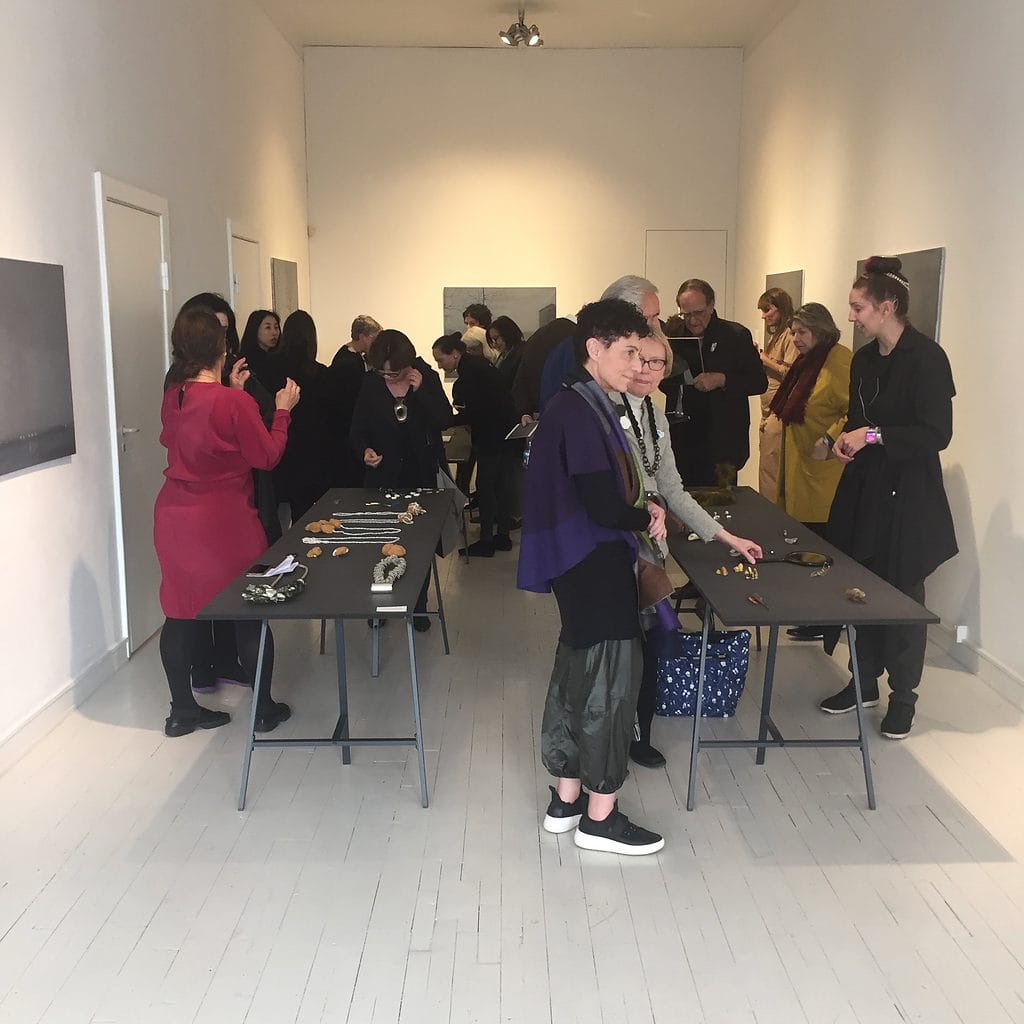
The exhibiting galleries were given a lot of space to display the work, with most of the Saatchi’s large rooms having only three stands per room. Some galleries such as Clare Beck at Adrian Sassoon (not pictured) built a room within a room to show small precious objects such as Giovanni Corvaja’s gold fur pieces. The Scottish Gallery had a pavilion with silver work and a single rare piece of jewelry by Peter Chang (sold). But most galleries took a minimal (sometimes austere) stance with display. Galerie Marzee’s awesome collection was shown in an enormous double row of steel and glass tables that required glass installer suction handles in order to remove the pieces. This provided great drama when looking at work and admirable upper body strength in the sales staff.
A few of the galleries displayed mini-exhibitions of a single artist such as Wendy Ramshaw at Lesley Craze Gallery, Kevin Coates at Ruthin Craft Centre, and Iris Eichenberg’s wonderful pink pieces at Galerie Louise Smit. Rome-based Alternatives Gallery showed an especially strong group including terrific jewelry and objects by Fabrizio Tridenti.
Two of the oldest jewelry galleries showed why they are at the top of the field with Galerie Ra (est. 1976) from Amsterdam showing beautiful new pieces by New Zealander Warwick Freeman made of laminated slabs of precious colored stones, and also a great selection of international artists. Electrum Gallery (est. 1971) had a large stand with established artists such as Gerda Flockinger, Charlotte de Syllas, and Bryan Illsley, and colorful paper work by youngish Angela O’Kelly.
Two of the newer galleries were Galerie SO from Switzerland (and also a great new space in London) and Amsterdam based Galerie Rob Kouldijs. Koudijs showed an installation by Alexander Blank called The Gathering of beautiful (and large!) black lacquered brooches of stylized animal heads. Galerie SO, in a minimal and elegant display, showed a combination of jewelry and objects. There were good challenging pieces by Bernard Schobinger and Manuel Vilhena as well as new work by silversmith Simone ten Hompel and metalsmith bad boy David Clarke. There were also a few non-gallery organizations exhibiting at COLLECT. Craft Scotland showed all craft media with strong jewelry by Stacey Bentley, Leah Black and Misun Won. Cockpit Arts, who house two large artist studio centers in London, featured good work by studio members Ruth Tomlinson and Kelvin Berk.
In contrast to the prevailing modernist architecture of most of the stands at COLLECT Galerie Sofie Lachaert built a witty (and all very white) display of wooden tables and wall mounted dress shirts in boxes with the jewelry neatly displayed on well starched white shirts. Mostly jewelry, Lachaert featured terrific work by David Bielander, Flora Vagi, John Iversen and Giampaolo Babetto and many others. Rosemarie Jager had a long table with a casually displayed array of ceramic and metal cups and vessels looking like the most amazing jumble sale ever. It was a fresh contrast to the everything-is-very-precious-object-on-plinth mentality of most of COLLECT. She had amazing new pieces from Bettina Dittelmann and Annamaria Zanella. Norwegian Galleri Format showed some of the most adventurous jewelry at the fair in the work of Anna Talbot, Hedda Bjerkeli and Elise Hatlø. Format also exhibited intriguing ceramics by Heidi Bjørgan.
It was hard to see all the great work at COLLECT. Even going every day of the run of the fair there was lots to miss. The galleries exhibiting jewelry moved things around and pulled new pieces from drawers so that the stands seemed to have new things you wanted each time you passed by. Add to this the many artists that attended COLLECT, it was a rich and exhausting experience. If you haven’t been, you should go. If you have been, I’ll see you there next year!
This lecture was presented at Out of the Box, a symposium organised by The Françoise van den Bosch Foundation in the Stedelijk Museum ‘s-Hertogenbosch, 11 January 2009
Contemporary author jewelry is still a rather young phenomenon. Although we can trace its origins back to the days of Jugendstil, its real story starts only some 40 years ago. Under the influence of an increasing economic prosperity things started to gain momentum and especially the last ten years developments in the field have accelerated: more and more jewelers enter the market, more and more specialized galleries are opened, more and more schools started jewelry departments, more and more fairs present contemporary jewelry. But despite the increase in numbers, jewelry still doesn’t count as a serious market where money is made and earned. Author jewelry is not a hot topic – the way design has gained a sexy status. The jewelry scene has an excellent international infrastructure, but on the other hand seems locked up in its self-preferred system. There are complaints, especially among the younger artists: it is impossible for every young maker to find a gallery, and how can you make a living out of one solo exhibition every two or three years and some exhibitions abroad? On the other hand galleries present a platform, introduce artists from abroad, their work and ideas, and bring jewelry from here to fairs abroad and collectors far away.
But there is always this uncomfortable feeling of isolation, and preaching to the converted. And maybe I am indebted to this situation too. There were other writers who resigned and even makers who resigned – because jewelry didn’t seem to make any progress. I stayed and I am part of the system. That is why I thought it would be a good idea to make an analysis of the position of contemporary jewelry today, especially with respect to the market, and to finish with proposing possible future scenarios. I have divided my paper into five steps.
1st step, kisses
In October 1996 Gallery RA organized the symposium Passion and Profession: Jewelry in past, present and future. Every period needs to investigate its future again and again. At the end of the day, the discussion leader wondered about the future: ‘What will become of you all? Will it all stay the same, sixty hugging and kissing goldsmiths, or will something happen?’. Well, twelve years later we are still hugging and kissing each other, that’s true. And you may wonder what happened in between. Did something happen indeed? Of course, computerized techniques are now widely applied, we have a very well organized internet information centre called Klimt, but author jewelry didn’t break through, it didn’t succeed in branding and marketing, the jewelry scene didn’t invent a young and fresh art-wise Cartier, or Van Cleef & Arpels, or an alternative to Prada and Gucci – and the public, the buyers and wearers, are aging.
Therefore questions about credibility and viability recur with cyclic regularity. You may wonder if author jewelry really needs to break out of its secluded niche, and if this kind of jewelry really is a lost case as some people think. You may argue that its value is precisely in the handwork, in the uniqueness, in the creation of attention, concentration, time and rest. But it depends on how you deal with these qualities and values in terms of how they are received in the outside world. These values are now often seen as repulsive and anachronistic, but they can be changed to become up-to-date, contemporary and progressive.
If we want more, if contemporary jewelry really wants to reach another public, preferably an art public – because art is the thing most of you feel related with – or a design public – especially now design is proclaimed as a new form of art, more attractive, accessible and understandable than most contemporary art – how should you do this? What strategies do you have? How do you kiss and entice the public and shake it awake?
2nd step, faith
We all know the work of Gijs Bakker and Emmy van Leersum, their white elastic suits called Clothing Suggestions (1970). Those suits and the happening, with friends of Gijs and Emmy and the artists themselves showing the suits in an empty gallery instead of a regular exhibition with objects in a showcase, promised a new attitude towards jewelry. Like the big wearable pieces Gijs and Emmy had been designing since 1966, those pieces were presented in the very first catwalk jewelry show that was held in the Stedelijk Museum, that ‘temple’ of contemporary art. It took place in 1967, and it was a very unusual event. It took the designers some effort to convince the museum about the necessity of it. For me, those events are a highlight in the young history of contemporary jewelry. In a recent exhibition at the V&A in London called Cold War, this work is interpreted in the light of fear and anxiety, as armoring for the body, as a protection against unknown but certain attacks from outside. It is an interesting interpretation but I’d like to stress the immense positive message of these designs: the advance to sculpture, and the fusion of body, clothing and adornment into one thing. It expressed an optimistic outlook. It presented something new and innovative at that time and it is still new today.
So where did you get since then and where do you want to be in let’s say ten or twenty years from now? What are your ‘preferred situations’ or ‘desired goals’?
In the past twenty years I have learned some things about jewelers. One is that in general jewelers are not designers, they are not designing the way designers do. Apart from some exceptions to the rule, jewelers are do-ers but slow-do-ers, makers but slow-makers, finders, people trying out, doing things over and over again, people who want to know everything about the materials they use. Jewelers are material boys and girls. But it doesn’t need to stay like this forever. Perhaps now is the time to focus on the market as well, to capitalize your talents – your excellent knowledge of materials, forms and techniques, your capability to work with precious materials. If some succeed in this, others can do it as well.
Another thing I have learned about jewelry is that jewelers are not very communicative. Their work is not created to tempt their buyers. And also in that sense jewelry cannot be compared with design, which is overtly designed to seduce the buyer by its use of color, form and market strategies. That is why everybody wants the newest i-pod and i-phone – they are designed to overrule all rational decision-making, they are bought on an impulse. Jewelry on the other hand, tries to convince. Jewelry is a matter of faith. You have to believe in it before you purchase it. But you can stir this faith by clever communication strategies.
3rd step, shine
We all know the work of Damien Hirst and the story of the diamond covered For the Love of God, which attracted more than 100,000 visitors to the Rijksmuseum in Amsterdam last year. Diamonds are bling bling, and 8601 diamonds on a platinum skull are hyper bling bling. The ‘spin’ around this work was excellent, starting with the origin of the skull, the story of the making, the spectacular use of numbers (more than 8000 diamonds worth between 80 and 100 million euro, not to mention the price of making, which was about 17 million euro), the way it was sold (to a consortium of investors and Hirst himself), the merchandising (t-shirts, buttons and the like), and the related sales records at Hirst’s Sotheby auction in September (a cool 100 million euro) – just before the financial crisis, lucky for them. 
Why is this work so successful? I think there are two reasons. The first is that the artist and his team are very good in manipulating the media. For the Love of God is a typical information age artwork, it is carried along on a flow of hype around the artist. The media lap it up and the people love to read about it. We live in an age of increasing numbers. We have never had more possessions then we have now, we have never had more stars, VIP’s and millionaires than we have now, we have never had more opportunity to hear about the delirious excesses of those who can afford it. And we have never enough, we want more: more stories, more comfort, more electronic toys, more innovations, more money, more diamonds. So Hirst’s bejeweled skull is reflecting the spirit of our time. It was hyped at the right moment, using the best media strategies.
The second reason for the success is the artistic quality of For the Love of God. It is an excellent piece of art, set with diamonds into the deepest parts of the eye sockets, the nose and the inside of the skull. Hirst didn’t choose the easy way. Every detail of his work is very well considered, including the use of the real set of teeth with one missing tooth, and the skills of the artisans from jeweler Bentley & Skinner. In fact part of the attraction of the work lies in its craftsmanship, the magic of all those diamonds set by hand. The references to well-known memento mori paintings and objects provide the work with an academic framework – for the connoisseurs who now have an alibi to simply enjoy the shine of this work of art. Rudi Fuchs called it ‘a piece of extraordinary, mad artistry’. In other words, this art object is a great work of art because it is the most talked about artwork in ages and because it succeeds in enticing all ranks of our society.
What can we learn from this? Well, that there are certain things that attract people, things like uniqueness, craftsmanship, shine, and preciousness – things you can easily handle as a jeweler, things you can all deal with as jewelers, whenever you like.
4th step, fame
A relatively new phenomenon is that of selling your work at the auction. For some time design has been selling tremendously well at auctions and fairs – prices of more than 150,000 euro for a design chair or cabinet are not exceptional any more. But prices have to do with fame and uniqueness. Old design from the nineteen-thirties to the seventies, sells because of a famous name and because of its rarity. New design sells because of fame and uniqueness – a design object in an edition of seven sells as a ‘unique piece’. 
There are also fine artists who have started to have auctioneering firms as their exclusive dealers, like Damien Hirst and Sotheby’s, or Annie Leibowitz and Phillips de Pury in London. Sometimes auctioneering firms have a gallery and the exclusive rights of sales, like La Galerie de Pierre Bergé in Brussels. The gallery commissioned Dutch designer Jurgen Bey to design a new collection of furniture-like art objects and sells them as unique pieces in an edition of two, three or four. Even his Sheep Jumping over the Fence, Stool and Apron, made in an edition of twelve, is sold as pièce unique.
In contemporary art and design things are moving that is clear. Therefore it is a pity that this relative young development is now surpassed by the financial and economic crisis. Now that the fortune of many Russian, Asian and dot-com moneybags is vaporized, how do auctions deal with this? Last months the atmosphere at the great London auctions was rather tame, and the Frieze Art fair in London, and Design Miami were not very successful as well.
And what about jewelry? Since last year there have been Brussels auctions by Pierre Bergé, who cares about contemporary jewelry and organized two jewelry auctions to date. That’s good news – perhaps. Jewelry is collected from the artists, sometimes from galleries but most of the galleries feel no enthusiasm to cooperate and you can’t blame them. It has been something strange indeed to see new jewelry in a lousy showcase, when you just recently saw it in a gallery context. It may look like heaven for the bargain hunter as well as for the artists who earn more when they sell at the auction compared to the gallery. But these are all short-term successes. Auctioneering firms are businesses, they won’t promote young and unknown artists, and they only believe in success. And besides, you can’t live from one sold piece, once or two times a year. The sales at the second Brussels auction – in December in the middle of the financial crisis – were not spectacular. More than half of the lots were not sold, and those that did sell just reached the low estimate price. The sole moment when the room became more active and something like an atmosphere of greed was apparent was when the last lots came under the hammer: a jewel by Hans Arp (one of an edition of 100) and one by Man Ray. It was again the old mechanism of the name and fame of the artist that was the main sales argument here.
5th step, luxury
But how can you possibly stimulate your sales then?
A position you can take is that of the underdog, you reconcile to the situation: so you agree you are not famous, you say you don’t like and need to be famous and you try to conquer another market, the one of the broad public and sell at fairs and in shops. To do this successfully you need to make concessions. You can’t present your work in the same way that you do in a gallery context. It needs an explanation, it needs little incentives that invite people to come nearer: a specially made edition, a colorful or shining ‘take-away’ jewel that is like a treat. I think it is perfectly fine to work like this, but take care, it is not easy at all, and the jewelers who are in this position know exactly what I mean.
Others address to the world of fashion, which is a fascinating and interesting market. The fashion world is interested in experiments, in innovative materials and typologies. If you really go into it you will see that here are striking similarities between fashion jewelry and ‘our’ kind of jewelry, and that there is a world to conquer. Like fashion, jewelry can be presentational. The British Naomi Filmer did catwalk collaborations with different and prolific British fashion designers such as Hussein Chalayan. In 2001 she designed glass and silver balls to fix the hands of the models to their backs while showing Alexander McQueen’s fashion collection – with the aim of making them assume the posture of a flamenco dancer. Her approach is conceptual and she also worked with video, photography and sound, with chocolate and ice. Besides that, she works as a designer for companies such as Armani and Burberry. There is nothing adventurous about that work, but Naomi knows how to work on different tracks, getting her work published in fashion, art and jewelry publications.
For some years the Austrian company Pierre Lang has organized the So Fresh Jewelry Award, an interesting mix of fashion, art and design. This is a new opportunity to get your work seen and appreciated in the context of fashion. But remember, applying means rethinking your work and aims, thinking out of the box.
To infiltrate the world of conventional jewelry is another option that finally – after having been dismissed by the art jewelry scene for decades – seems accepted now. We all know that people are like magpies who love sparkles. People are even willing to transform the ashes of their beloved ones into a diamond – diamonds are big business. Why not convert to the diamond? There are cautious signs of a new approach, coming from this other world of luxurious jewelry: jeweler Lyppens here in Amsterdam wants to work with Ted Noten on a new line of black diamond jewelry. This is a brand new initiative that is still in its infant stage but has the smell of something new and fresh.
Some years ago a South African diamond mine owner and former architect called Hilton Judin started a project introducing a new line of diamond jewelry called Very Lustre. It is partly designed by people from our scene such as Dinie Besems, Marc Monzo, Hilde van der Heyden and Karl Fritsch, and partly by interesting designers like BLESS, Studio Job and Adam und Harborth. The idea is to be both ‘exclusive and accessible, bold and withdrawn, valuable and ordinary’. As Hilton Judin states, Very Lustre is ‘A common standardized but intricate collection of diamond jewelry based on concepts and statements, produced in collaboration with several independent authors’. It is a pity that you can’t find much information about this new jewelry collection. After meeting Hilton Judin some years ago at the Milan Furniture Fair where he showed me the first prototypes from Marc Monzo, I have never been able to reach him again. The designers I spoke with have had the same experience: the last they heard is that the jewels are sold in Comme des Garcons Guerrilla Shops, and that Hilton Judin is still going on with this project. Anyway, this fusion of diamonds, fashion and design, of luxury and concept, is a fascinating example of how worlds can merge in today’s society.
If the diamond is not your thing, you can also focus on other gems, synthetic or natural. This is what Truike Verdegaal is doing with her Maria Lux line of ‘prêt-a-porter’ jewelry. This project was encouraged by contact with Lilian Driessen, a fashion and accessories designer in Amsterdam. In all these years Verdegaal has learned not to expect too much from having her own label, but she also experienced that the moment you really start working on it, and you enter the world of the glossy magazines, things can really go fast. It is the power of numbers and multiplication that counts.
I am convinced that our boxed in jewelry scene will start changing pretty soon. It can’t stay the way it has been the last 40 years. Our society has changed and so the jewelry scene will change. In the near future jewelers will work on different tracks: for the gallery and for their own label, the fair, internet sale, house sale parties or any other initiative. The jeweler as a businessman: why not? But therefore connections between artists and galleries and clients should be more rational and businesslike. A jeweler is an artist who creates a product and wants to sell it. He/she has something unique to offer, something handmade, thoughtfully made and carefully made, in very small editions, or more often completely unique and made from precious or special materials. This is your capital. I strongly believe in what fashion designer Alexander van Slobbe, the new artistic director of the design Academy in Eindhoven, says: ‘The new luxury is that of the small-scale, the hand-made, and permanence’.
The gallery is the in-between salesman who wants to sell this luxury product. This is business, not an altruistic affair. Perhaps it once was but times have changed and it is now time to re-invent author jewelry. The numbers of jewelers, galleries, fairs, and other initiatives and opportunities are growing – complexity will grow with the numbers. And so you will have to rationalize your connections and look for new collaborations. You need contracts, clear agreements, more openness and room for negotiations, and initiatives of the artists that go beyond the confines of the gallery. You should try to work on different tracks. In the end all parties will profit from it.
Complexity opens up new possibilities. I think it is time to step out of the comfort zone and make yourself seen.
PHOTOS (top to bottom):
Gijs Bakker and Emmy van Leersum
Clothing suggestions, 1970.
Gijs Bakker and Emmy van Leersum
Clothing suggestions drawing, 1970.
Gijs Bakker
Shot, 1996, nylon
Chi ha paura . . .? design CHP06
Katja Prins
Bound by blood, wood
Chi ha paura . . .? design CHP41
Lisa Gralnick
Tiffany Ring (The gold standard #11)
2005, gold, acrylic
Ted Noten, Fashionista
Purple Haze Necklace, 2009
edition 1/8, glass-filled nylon
Ted Noten
Super- Bitch-Bag Lady K
2008, edition 6/7, Walther PPK, engraved with flowers and gold plated, cast in acrylic, found handbag
Individuals have as many reasons to buy and/or collect objects as there are objects available. Jewelry is one of the more personal passions in collecting due to its connection to our bodies. After all, most objects cannot be presented to the world on a daily basis in such an intimate manner as jewelry. We present a little of ourselves with each brooch or necklace worn.
Generally there comes a time in the lives of collectors to consider sharing pieces of our passion with the rest of the world through donations to museums and other institutions, thus promoting jewelry as an art form. This desire to give back is innate in most of us, even if we have varying secondary reasons attached to our giving. AJF is undertaking a project to provide a primer to inform interested collectors in navigating the process of donation. I have been asked to begin by providing some basic information that identifies the delights and pitfalls associated with the process.
In the spirit of full disclosure, I have not yet been successful in donating jewelry to an institution. I have, however, donated pieces from our contemporary ceramics collection to museums for the past five years. It has been extremely rewarding but I must tell you that I had been trying to donate work for ten years prior to our first success! This hints at why AJF wants to prepare you for and lead you through the forest. Believe it or not, it may be difficult to give your jewelry away! In celebration of your generosity, I present Life Lessons 101 for your desire to share.
Lesson One: critically assess your gift
The first step to success is to realize that there are many differences between personal collections and public collections. As in all aspects of life, there is never consensus. One size does not fit all, and a beautiful piece of jewelry that adorns your body so specially may have no place in the curatorial agendas of an institution. This is especially true for jewelry because one of the key components in the personal collection, the connection to the body, will never be duplicated in a museum setting. The extension of yourself that jewelry provides is not possible in an institutional exhibit. It is critical for you to gain the objectivity to look at your pieces with a museum’s eye. You can begin by looking critically at a museum’s collection, reading its curatorial statements, and by speaking to others who have been successful in lending or donating to the institution.
Lesson Two: do your homework
Once you believe that you have jewelry that might delight a curator or director of a museum, begin to research your options by looking at various public collections for a good fit. Is the museum focusing on historical jewelry and ‘light’ on contemporary examples? Is the institution wed to jewelry only from Western Europe? Is the museum strong in some areas of decorative arts, design or craft, but not so in jewelry? There are many more appropriate questions than these examples, but you must ask them and others to ensure the best repository for your donation in order to succeed.
Lesson Three: find the niche
Armed with your research, speak to others who might have experience with various institutions. This information can save you a lot of time and potential disappointment. Someone may know things from experience that you will not find in the museum’s printed material. Realize that most times there is more than one ideal home for your donations. Start with your first choice and proceed. It is imperative that you answer the questions related to why you have made your choice. Do you only want your pieces in a large, nationally known institution? Do you particularly want your gifts confined to a particular region? Close to home? Or does the idea of helping build a strong collection in an institution just starting to expand its jewelry holdings appeal to you?
Lesson Four: make a connection
Once you have made your decision, contact the institution. You might start with a letter or e-mail of introduction to the appropriate curator or director. Share you passion and desire to enhance the museum’s jewelry collection. Tell them of your collection’s focus and tease them with images if possible. Make it clear that you are looking to gift to the museum, unless you have other intentions. Ask for a face-to-face meeting at their convenience. Or invite them to see the work in your home. In short, convince them of your desire to donate and tell them why you have chosen to approach them in order to gauge their interest.
Lesson Five: be prepared
You know what they say about first impressions! Do not let yourself fall into the mind trap that a curator will gush about your intentions upon meeting you. After all, curators and directors are the stewards of the collection and they have seen a lot of work. Do expect courtesy and integrity and you won’t be disappointed. Even if your work is not felt to enhance a particular collection, a sensitive curator might lead you to another institution with a better fit.
Try not to have unrealistic expectations. The days of museums acquiring an entire collection are numbered. Try not to present an all-or-none condition for your gifts. Today this may amount to the kiss of death. If you are sincere about a gift to a particular museum, play by their rules and limitations. The result just might be the placement of one or more of your pieces in the collection of your choosing.
Feel free to express your desires about your pieces. If having the work on exhibit is your primary goal, you must discuss this with the museum. Smaller museums may be able to accommodate this request better than the large museum. If you simply want to add to the institution’s collections without stipulations, you may be more successful in more venues.
Expect conditions for accepting the gift from the museum as well. An institution may ask for a monetary gift to maintain the collection or for support for the institution at large. I have known at least one museum that made a financial gift a condition for accepting the work. Let nothing surprise you.
Lesson Six: finally . . .
Your work is not finished with the acceptance of the gift. Most institutions insist that the donor obtain an appraisal of fair market value. Rarely, a museum will undertake or share this requirement, so discuss by all means. Certified Appraisers for contemporary art jewelry are few. AJF plans to provide a list to its members in a future newsletter. Appraisers may ask for a percentage of the fair market value as their fee, may give you a flat fee, or may negotiate other arrangements depending on several factors including number of works to be appraised, ease of finding secondary market data, or having to establish a comparative value based upon like work. Again, discuss your options. Please realize that the IRS has put the onus on the appraiser if there is any question concerning the legitimacy of the fair market value appraisal. An appraisal therefore becomes a significant legal document.
The appraiser may ask for a copy of the institution’s Deed of Gift of your donation as well as a letter of acceptance of the gift from the institution. The appraiser also will expect you to provide the following information: title, date, artist, dimensions, mediums, provenance, how purchased, price paid, exhibition/publication history, and whether the piece is unique or part of an edition. The IRS requires most of this information as well. There are tax benefits associated with gifts to non-profits, but specifics will need to be addressed by your accountant or tax filer depending on your tax liability.
After all the T’s have been crossed and the I’s dotted, the jewelry you have treasured will become part of a greater whole. It will now belong to all of us for our education and enjoyment. There is a great sense of accomplishment and pride associated with being able to share one’s good fortune with others. Although the process can be daunting at times the rewards are great. Sharing your jewelry with new eyes fosters better understanding and appreciation of the field we have chosen to love. By all means be generous. What better way to give a part of yourself to posterity?
PHOTOS
Brooch, Robin Kranitzky and Kim Ovwerstreet
Ron Porter, AJF member and author of this article
I recently completed the Graduate Program in Fine Arts at the California College of the Arts in San Francisco. Submitting my portfolio to the Jewelry/Metal Arts Department, I was accepted into the program by the Program Chair, Marilyn da Silva with the approval of the Graduate Admissions Committee. I chose to attend CCA because of its enthusiasm for cross-disciplinary exploration and its emphasis on a greater awareness of the global context of contemporary art. Rooted in critically engaged studio practice, the program explores both the specifics of particular disciplines and the points of interaction and overlap among disciplines.
During my two years at CCA, I worked in close contact with my peers whose skill sets comprised ceramics, furniture, glass, jewelry/metal arts, textiles, media arts, painting/drawing, photography, printmaking, sculpture and social practice. This interdisciplinary aspect to the program resulted in an absence of jewelry within my MFA show. Given total freedom of expression, I made a conscious decision to let my concepts lead me to my methods of making, even if it lead me away from what I was familiar with. There is no doubt however, that my background as a jeweler informed my work at CCA. Five months after completing the program I am coming to terms with my experience and what it has meant to my artistic practice.
CCA’s graduate program is housed on the San Francisco campus and is comprised of two areas of study, studio practice and academic seminars. While engaged in their studio practice, students create artwork and receive feedback from faculty. This is supplemented with courses in the history of contemporary art aimed at providing grounding in critical theory. The Jewelry/Metal Arts Department, housed on the Oakland campus, is geared toward undergraduate study. While at CCA I came to the conclusion that the two campuses, and in relation, the two programs I was affiliated with, were very much separate entities.
I recall one of the first papers assigned in my Contemporary Art History and Theory Seminar in which I was faced with the task of placing my practice within contemporary critical concepts. Required to compare my work to three artists or movements covered in the curriculum, I chose Rosemarie Trockel, Guy Debord and the Arte Povera Movement. Unable to pull from the craft history I was familiar with because it was not included in the course, I quickly became aware of the new dialogue in which I was engaged. Studio critiques with faculty members worked as extended dialogues to the academic content of seminars. Similar to seminars, the field of Art Jewelry was not a part of the conversation. In critiques where I presented jewelry to my review panel I received responses such as, “Why not industrial design?” or “This belongs in the museum store, not the museum.” These comments communicated the sentiment that jewelry was unfamiliar as fine art. Its functionality and peculiar position between art, design, craft and fashion did not easily fit into the fine art dialogue.
For a period of time, I put my Art Jewelry books on the shelf. No one knew who Myra Mimlitsch-Gray or Ted Noten was. Therefore, referencing these artists in my critiques and studio practice meetings only confused things and made communication difficult. It also underlined the fact that these artists were not on the radar of my peers and instructors in San Francisco. They were craft, and specifically jewelry and metal work, which was a different dialogue. To begin building a foundation that would allow me to address my craft sentiment within the contemporary critical dialogue, I explored artists like Josiah McElheney, Anne Wilson, Cornelia Parker, Claudia Tennyson, and Grayson Perry who were not exclusive to craft but undeniably related.
While the more traditional studio craft was not part of the graduate program curriculum, there was a great deal of activity surrounding craft-related practices such as “DIY” and “Subversive Craft”. In February of 2008 the College Art Association hosted a conference in Dallas, Texas. One of its lectures entitled, Gestures of Resistance: Craft, Performance and the Politics of Slowness, pointed to an emphasis on the use of craft in contemporary art, “use” being the operative word. It seemed to me that craft was being revisited within contemporary art as an action where the object made is not revered for its craftsmanship but exists as documentation of the physical act of crafting.
I could not divorce myself from a reverence for craftsmanship; however, while at CCA I decided to ask myself the question, “Does it make sense to actualize all of my ideas in a jewelry format?” For the time being, I took on the mind-set of a fine artist invested in concepts of craft. My jewelry skills became part of my arsenal of art-making tools rather than techniques that defined me as a jeweler exclusively. I had to think about why I made jewelry and use that information as a guideline to build a new practice, which I thought of as an extension of my jewelry practice. I considered both to be equal and related but allowed to function independently.
These past five months following my graduation I have been trying to figure out my stance. The urge to make sense of the validity of jewelry making as a fine art practice and fine arts suspicion of it is always present. Laboring for a tidy conclusion is quickly becoming tedious and boring. For now I’m living within, understanding the in-between and asking questions about both. Nobody gets off the hook, everyone is valid. Recently, I re-read Gert Staal and Ted Noten’s manifesto, In Celebration of the Street, in the vol 27 no 5 issue of Metalsmith magazine. It struck me that without the institution of art, jewelry making is a powerful craft in itself. Making the objects that serve as dialectic units, jewelers create symbols that lubricate the rituals that comprise everyday human life. So here are the new questions I’ve been asking myself: Does that die when you take it away from the everyday sphere and elevate it to the museum or gallery? Or does it perhaps serve to highlight this unique function of jewelry?
*Click to view my thesis to see the culmination of my graduate experience.
A chance meeting with Bob Ebendorf at Penland and my penchant for his work has led to an on-going pen-pal relationship. It has been amazing to me that such a casual relationship could grow into a satisfying friendship based upon spirited discussions of the scope of contemporary jewelry.
So it was with a mix of expectation and trepidation that we accepted an invitation to visit him at East Carolina University, meet his fellow faculty and students and see his most recent exhibition at the Imperial Centre in Rocky Mount, NC.
We arrived Friday in time to attend an exhibit of mixed media jewelry by BFA candidate Callie Huskins. She created mixed media pieces of wax, paper, enamel and pearls. Allof the Metals faculty was in attendance and we were treated to a tour of the metals studios and a sneak preview of work by MFA Candidates, Daniel DiCaprio and Shand Stamper, and MFA graduate Marion Sak. Dan creates intimate, beautifully carved work from rare woods, gold and silver. Shand’s enamel pieces are informed by her experience with Hurricane Katrina, and Marion has created a body of beautifully crafted hollowware.
Dinner and jewelry conversation with School of Arts and Design Chair Linda Darty, and Bob capped the evening. Linda had just been awarded the ECU Faculty Lifetime Achievement Award for Excellence in Research and Creative Activity, so we were able to join in celebrating her achievements.
Saturday brought the short drive to Rocky Mount to see “Past and Present: a Continual Journey” at the Imperial Centre for the Arts and Sciences. The Centre is a beautifully restored and redesigned tobacco warehouse. Bob’s exhibition was shown in two of their spacious minimalist galleries. Although not arranged chronologically, the eighty brooches, necklaces and objects represented the full spectrum of Ebendorf’s mature work. All were from his private collection, so well-documented extraordinary work lay alongside rarely seen examples representative of fifty years’ of jewelry making. It was truly a treat for the jewelry lover. The exhibit is to continue to May 17, 2009.
A visit to the other gallery spaces in the Centre treated us to a juried show of Carolina crafts, a one-person show of sculpture, and one of painting.
Dinner with ECU metals faculty and MFA students at the home of assistant professor Tim Lazure completed our art jewelry weekend. The weekend was filled with all things jewelry, a delicious treat for any AJF member. The ECU metals facilities are state-of-the-art, and if the student work we experienced is any indication, the educational experience at ECU is rich indeed. We were impressed with the quality, craftsmanship, and unique vision of each student’s work. Importantly, none of the student work was a simple tweak of jewelry by their professors.
My pen-pal relationship with Bob has now grown because of this visit. Bob has just been asked to extend his tenure as Belk Distinguished Professor for another five years. I look forward to what those five years will add to his body of work and to art jewelry scholarship.