May 30th, 2010 08:05
Born and raised in Matsue in rural Japan, Mari Funaki came to Australia in 1979. Expected by her family to make a traditional marriage, she found a new life in Australia while travelling the world as a young woman, staying in Melbourne to become a leading member of the city’s cultural renaissance in recent decades.
Funaki’s story is exemplary of how shifting country and culture can unleash an individual’s potential. ‘If I had remained in Japan, I would never have been doing what I am doing now. In Australia I learnt freedom to express myself and to build my own identity.’ Australia is composed precisely of such stories of transplanted lives and talents.
In her late thirties Funaki found her true path in gold and silversmithing. She retrained at RMIT and plunged into the community of makers centred on the university, including a traineeship with Marian Hosking in 1993. From then, Funaki was central to Melbourne’s vibrant art and design, not only as a maker but as an enthusiast and patron through her gallery, tirelessly promoting contemporary jewelry.
The crisp excellence of Funaki’s jewelry was immediately recognised, and from her graduating year was included in major national and international exhibitions, museum and important private collections, and awarded important prizes both in Australia and overseas. Her approach was distinctive, with a repertoire of elegant angular black steel and fine gold brooches, rings and bracelets established in the first decade; this gradually expanded to include complex containers. These sprightly forms sometimes resembled insects or leaves, but were often simply analogues of physical principles, always beautifully resolved.
Funaki’s approach was intuitive, firmly rooted in Japanese ways of seeing: ‘Packaging is one of the most recognisable characteristics in Japanese culture. The box is not just to contain something, but it is used to present something, to treat it with respect and add an air of anticipation.’ At first the containers sheltered hidden spaces, but over time became freer, more experimental, with internal spaces discernible only through close observation; new shapes suggested the built environment. Recently, some works were scaled-up to make large sculptures. Working with a personal vocabulary, she prized the way each piece suggested emotional states or memories. Refined, elegant, impeccable, her work distilled observation into beauty.
Importantly, Funaki created Australia’s most important private gallery for contemporary jewelry. Passionate in her commitment, she saw that Australia’s contemporary jewelers needed a showcase and opened Gallery Funaki in 1995. This tiny bolt-hole is one of the world’s best addresses for contemporary jewelry. Funaki’s vision was international: she wanted Australian work seen in the broadest context, showing Europeans Otto Künzli, Karl Fritsch and Nel Linnsen, and New Zealanders Warwick Freeman and Lisa Walker, together with leading Australians such as Hosking, Carlier Makigawa, Sally Marsland and Julie Blyfield. This was a symmetrical dialogue: Funaki tirelessly organised Australian exhibitions abroad and welcomed many artists to her adopted country.
Mari Funaki finally succumbed to the breast cancer she battled so valiantly. She is survived by her beloved mother Mitsuko and brothers Masaya and Takuya Funaki of Matsue, Japan, her friends in the Australian and international artistic communities, and the legacy of support for her fellow-artists. She died at the height of her powers, working on new sculptures. On 6 August the National Gallery of Victoria will open her solo exhibition at its Federation Square building, and later this year the National Gallery of Australia in Canberra unveils a two-metre high sculpture by Funaki, commissioned to celebrate opening of its new galleries. And in her North Carlton garden, Mari Funaki’s cherry tree awaits its next spring blossoming.
May 21st, 2010 03:05

Just a reminder to all you young, talented and yet uncomfortably poor contemporary jewelers out there that it is time for you to be applying for AJF’s EAA. FYI for those of you saying WTF at all the acronyms, the Emerging Artist Award is a $5000 US prize given out by Art Jewelry Forum each year to a contemporary jeweler at the beginning of their career. You must have competed your academic or professional training, have been out of school for at least a year, and not yet achieved the distinction of a solo exhibition in a commercial gallery or museum. If you fit this description, and your jewelry is brilliant but still awaiting its audience, then the EAA is definitely for you. The deadline for submissions is the 13th June 2010. You can find out more about the award by clicking here. To submit your entry, go to www.callforentry.org/
The winning entry will be selected by our jury of esteemed jewelry experts: Namita Wiggers, curator at the Museum of Contemporary Craft, Portland; Susan Beech, collector and long-standing AJF member; and Sharon Massey, jeweler and winner of the EAA in 2009. You can find out more about past winners of the EAA – such as Andrea Janosik – by clicking here, but all you really need to know is that they were showered with praise and glory and cash, and their lives have become like a craftsperson’s dream, filled with enormous studios, wine and cheese, happy dealers, enthusiastic collectors and sympathetic critics.
Finally, if you aren’t a contemporary jeweler at the beginning of your career, but you like what AJF is doing by way of the EAA and our other grant schemes, then why not consider becoming a member? Your membership donation supports jewelers (and those who support them), and gives you access to a group of people from around the world who are passionate about contemporary jewelry, so much so that they are prepared to put their money where, to paraphrase an old saying, their necklaces, earrings, bracelets, rings and brooches are. (To find out more about joining AJF, click here.)
March 31st, 2010 12:03
One of the big news stories from across the Atlantic has been the significant donation of almost 500 pieces of jewelry from the Marjan and Gerald Unger collection to the Rijksmuseum in Amsterdam. (To read more about the donation, click here.) Marjan Unger, a leading authority on Dutch jewelry, has among other things published a book called Het Nederlandse Sieraad in de 20ste eeuw (Dutch jewellery in the 20th century), which unfortunately is not yet available in an English translation. One of the notable things about the Marjan and Gerald Unger collection is its obvious agenda in relation to Dutch jewelry history, what the Rijksmuseum press release somewhat cryptically describes as an ‘academic approach’. AJF was keen to find out how Unger’s collecting activities were affected by her scholarly interests, so we asked her to summarize how she approached Dutch jewelry in her book.


Recently Unger received a doctorate from the University of Leiden. Her thesis, titled ‘Jewelry in Context’, extends the approach she developed in her book about Dutch jewelry in the twentieth century, and argues for a multi-disciplinary approach to the study of jewelry that will avoid the ‘misconceptions and tunnel vision’ that have, in Unger’s opinion, afflicted most writing on the subject. (You can read about her research by clicking here.) And if you want to know more about her ideas, click here to read Margriet Soper’s account of a recent conversation with Unger.
March 6th, 2010 06:03
Production is a sensitive concept within contemporary jewelry practice. Standing between fine art on one side and design on the other, contemporary jewelry has tended to appeal to fine art’s love of the unique rather than design’s love of the many. Yet this conceptual manoeuvre is in many ways directly opposed to jewelry’s own history and traditions. As French jeweler Benjamin Lignel recently wrote in Metalsmith magazine:
One of his points is that the idea of serial production as an anemic copy of the original only exists as long as we persist in seeing craft as a last stand against mediocrity in a society awash with the trashy results of the industrial revolution. As Lignel suggests, ‘When one approaches reproduction as its own media, exciting precisely because it belongs to, and reflects upon, industrial culture, the negative relationship that binds original and serial copy ceases to exist.’ Production jewelry, in other words, is less a victim of industrial processes and more a medium through which jewelers can engage with the issues of production, economy and distribution that are central to industrialized societies.
Most productive (excuse the pun) is the idea that serial reproduction provides an alternative model through which jewelry (and craft) might be theorised – a model that allows us to side-step the tyranny of the fine arts. Lignel writes:
These issues are particularly relevant to countries where production jewelry has an established role in providing a living for the jeweler, where jewelers expect to live off their work. Without production jewelry, it would be impossible to survive solely from your jewelry practice. We have always recognised that there is a financial dimension to this kind of activity, but how much attention have we given to its theoretical possibilities? (To read Lignel’s essay, click here.)
If you happen to live in San Francisco, or are passing through the Bay area on Thursday 11 March 2010, you have the opportunity to take part in a discussion of these very issues. The San Francisco Museum of Craft + Design is presenting a panel discussion called Jewelry Designers/Jewelry Makers: Who’s Making It? in association with their current exhibition Designers on Jewelry: Twelve Years of Jewelry Production by Chi ha paura…?. Participants include David Cole, Sandra Enterline, Mike and Maaike, and Julia Turner, and the event will be moderated by Marilyn da Silva. To find out more about the details of the event, click here.
February 24th, 2010 07:02

It was old home night for many of the some 30 people who attended the gathering at the Shibumi Gallery in Berkeley (Feb. 6), hosted by (the pregnant) April Higashi and her husband, sculptor Eric Powell.
Collectors and artists mingled with the guest speaker, Tina Rath, on sabbatical from her teaching position at the Maine College of Art. She was welcomed by many old friends, including Marilyn and Jack da Silva, Donald Friedlich, and Donna Briskin.
Tina Rath’s ‘wanderings’ have taken her from California (where she was president of the local Metal Arts Guild), for graduate work into Amsterdam, to her present position. As an early admirer of her work I was pleased to wear some ‘vintage Rath’ . . . three wire pendants worn as a collective, earrings and a chunky ring described by her as an ‘urban pacifier’.
I was struck by how her work has softened from the earlier wire designs to pieces incorporating fur, typically mink. Her new Wanderlux installation is larger, bolder, and reflects her new enchantment with the natural world.
February 23rd, 2010 09:02
Some very exciting news from the agricultural heartland of America. Lena Vigna has taken up the role of Curator of Exhibitions at the Racine Art Museum. (To visit the museum’s website, click here.) The Racine Art Museum is an important collector of contemporary jewellery, and stages a number of jewellery exhibitions each year, contributing significantly to the health of the American contemporary jewellery scene.
Recently AJF published an interview with Bruce Pepich, the director of Racine, which you can read on the AJF website by clicking here. AJF has also published an article by Lena Vigna on heirlooms in contemporary jewellery (to view this text, click here), as well as supporting Vigna’s exhibition Ornament and Excess: Jewelry in the 21st Century, which is currently on display at the Miami University Art Museum until 10 July 2010. (You can visit the museum’s website by clicking here.) We congratulate the Racine Art Museum and Lena Vigna, and look forward to an exciting exhibition future for contemporary jewellery.
January 21st, 2010 07:01
Stefano Catalani joined Bellevue Arts Museum in 2005, and has recently been appointed Director of Curatorial Affairs/Artistic Director, effective February 12, 2010. He has conceived and organized 17 (and rising) acclaimed exhibitions exploring the ever-evolving field of art, craft and design. Major exhibitions include ÜberPortrait, Ed Pien: Haven, Dim Sum at the On-On Tea Room: The Jewelry of Ron Ho and Garry Knox Bennett: Call Me Chairmaker, among others. Paying special tribute to Northwest artists, Catalani has showcased the work of some of the most promising talents of this region, including Mandy Greer, John Grade, Etsuko Ichikawa and Tip Toland. Four exhibitions curated by Catalani have gone on nationwide tours to other museum venues, introducing on-the-rise craft artists to new audiences across the continent. Traveling exhibitions include A Tapestry of Memory: The Art of Dinh Q Lê, Mandy Greer: Dare alla Luce, Garry Knox Bennett: Call Me Chairmaker andEd Pien: Haven.
During his tenure at BAM, Catalani has written and/or contributed to nine exhibition catalogues published by Bellevue Arts Museum; among them an award winner from the American Association of Museums (2007, Dim Sum at the On-On Tea Room: The Jewelry of Ron Ho).
Highly regarded in the field of contemporary art, Catalani has been chosen as a nominator for many awards, including the Neddy Fellowship Award (Behnke Foundation, Seattle, WA), the Irving and Yvonne Twining Humber Award for Lifetime Artistic Achievement (Artist Trust, Seattle, WA) and the Contemporary Northwest Art Awards (Portland Art Museum, Portland, OR). He also serves as a guest lecturer at the University of Washington, Evergreen State College and other educational institutions.
An Italian native, Catalani relocated to Seattle in 2001. His classic studies in Italy provided him with a strong theoretical background in art history and philosophy. At Bellevue Arts Museum, he focuses on “craft as a cultural signifier,” stressing the social implications of craft.
December 17th, 2009 02:12
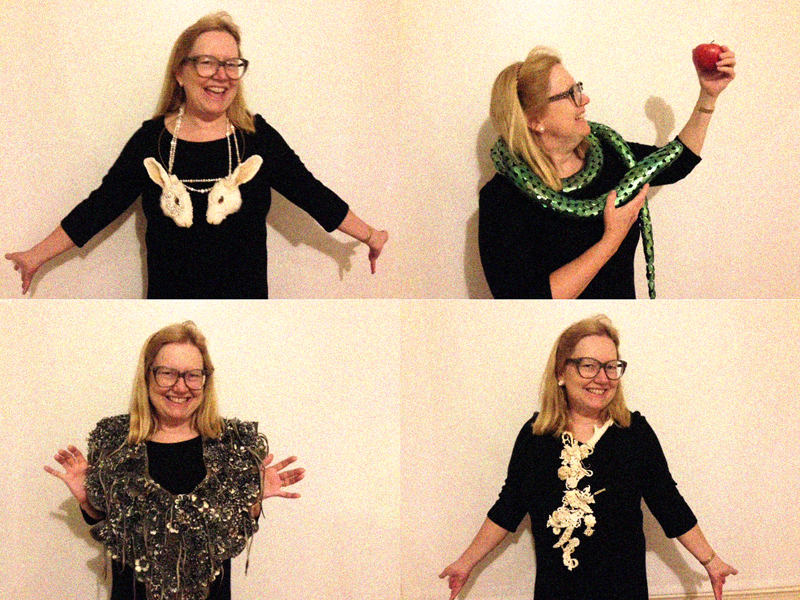
The big news: a new fabulous necklace, AND a new husband! He’s the old guy; the youngster is my cute son. This was taken just after the wedding, which was November 25th.
November 16th, 2009 02:11
The courageous and accomplished artist Myra Mimlitsch-Gray left the comfort zone of her studio and the academic world and dove headfirst into a noisy, male-dominated world, when she began her 13-week artist-in-residency at the Kohler factory in Wisconsin in 2007. Earlier in May she spoke about her experience to enthusiastic response at the Philadelphia SNAG conference. The Kohler factory is better known for its ceramic toilets and bathtubs than artistic production but it has quietly maintained a residency program for many years. On Veterans’ Day she shared more of her experience with a large audience of faculty, students, graduates and other artists at California College of the Arts, Oakland.
Mimlitsch-Gray, who is best known for her superb forging techniques and innovative flatware, had first to get used to loud rock music, piles of what appeared to be left-over junk, and factory shift routines. She also needed to bond with some of the employees (350 men and only seven women) and ask help with heavy lifting and crafting the wooden frames she needed to make her projects. She worked on a series of large cast iron objects, including some delightfully free-spirited cast-iron frying pans to take advantage of Kohler’s facilities. She still has a buzz in her ear from some of the rock music, but fond memories of the people she worked with. Myra says she appreciates the industrial experience, which helped give her the chance to reinvent herself.
Currently chair of the art department at SUNY New Paltz, she is now juggling a triple role as studio artist, teacher, and administrator over an 800-strong student body. Myra expressed gratitude for her Kohler residency and regrets that this program is now on hold. What will she do next? As she mulls over creating her next body of work she is at least sure of one thing: “I’m not going to repeat myself.”
October 13th, 2009 01:10
Bruce Pepich, AJF curator member and Executive Director and Curator of Collections at Racine Art Museum wants all AJF members to know that RAM now has Donna Schneier’s gift of 49 pieces displayed alongside works by the same artists that are already in the collection or are additional new gifts from other donors. RAM has the jewelry paired with other examples of jewelry, jewelry and hollowware together and, in the case of Beatrice Wood and Garry Knox Bennett, jewelry with ceramics and furniture. There are about 120 works on display in the main gallery.