July 25th, 2010 02:07
A title such as Broochmania conjures images of a somehow frantic exhibition. A craze of brooches, where the viewer is confronted with a wild and endless display of the ornaments that have accompanied mankind for a long, long time. However, when entering the bright and quiet space of the Rob Koudijs Gallery in Amsterdam, we are greeted by an exhibition that is sober, yet full of talent.
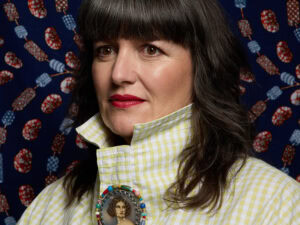
The title, as commonly happens, came before the collection was even created: Karen Pontoppidan, jewelry artist and head of the Ädellab (the jewelry department of the Konstfack University College of Arts, Crafts and Design in Stockholm) envisioned a project that involved students of her academy from the first year to recently graduated masters students. Rob Koudijs, owner and manager of the Amsterdam based gallery hosting Broochmania, welcomed the idea with the open and daring attitude that characterizes his exhibitions and that often regale the audience with refreshing exhibitions and unexpected artists. Through a series of five workshops, the Ädellab students had studied the history and diverse facets of brooches. The students were then encouraged to translate their recent experiences in brooches that would be suitable for exhibition in a prestigious gallery.
Brooches are perhaps the oldest type of jewelry. They started their lives as fibule, ornamental clasps used by Romans, Greeks and also by Celts and migratory tribes in Europe even before the Bronze Age. Those early fibulae were simple in shape (a kind of large safety pin made of simple materials, like thorn or bone) and in function (to hold clothing together). But soon they began to change form and acquire a different function: to represent the identity of the wearer, indicating ethnicity, rank or status. And so they turned into brooches, which through the centuries have been produced in all kinds of shapes and materials and used for all kind of purposes. From the Victorian lockets that held the hair of beloved or departed ones, to those badges that indicate ideology and preference, to the cherished mementos that people want to keep close to their bodies, brooches are good examples of the powerful nature of jewelry.
The theme of the exhibition is both extensive and rich. Brooches are, perhaps, among the most frequently produced ornaments by contemporary jewelers. Their possibilities are almost endless and their prominent display on the chest make brooches a remarkable media for communication. Given this fact, it is a pity that there were not that many Ädellab students taking advantage of the opportunity.
Dutch architect Ward Schrijver was invited to Stockholm to act as a curator for Broochmania. The curatorial experience proved to be a tough one. Absent students (and their expected works), great ideas with technical problems or last-minute pieces that simply fell apart in the hands of the curator, left Schrijver with a smaller choice than expected. A collection of approximately twenty five brooches executed by a group of only thirteen students and graduates made it to the showcases of the Rob Koudijs gallery. As a last minute addition, a small collection of necklaces also made by the selected students was added to enhance the exhibition. And the chosen necklaces were as interesting as their maniac brooch companions.
Schrijver based his selection in the novelty of the proposal, as well as in the aesthetical, formal and technical qualities of the works. Being an architect myself, it was not difficult to spot the hand of a colleague in the curator’s approach. The manufacture of all the chosen pieces is superb and a certain constructivist style can be perceived through the exhibition. Examples of this are the analytic, geometric style of Hanna Lundborg’s work, the sculptural qualities of Emille de Blanche, or the topographic appearance of Jacob Erixson’s massive brooch. A creative, effective and simply beautiful approach to the pinning and closing mechanisms of several of the pieces remains a constant through Broochmania, found in the work of Yi Shen, Maki Okamoto and Dana Hakim.
Although small in number, the collection is diverse, with a variety of materials and techniques that show the different cultural backgrounds and interests of the makers as well as an inquisitive and experimental approach to material. Maki Okamoto’s Spoon brooches show an interest in challenging the conventional use of brooches and inviting the wearer to become engaged with her pieces. Recovered silver spoons are transformed: the hollow containers become voids, the decorations on their handles are erased and weighty, tactful nuggets (which now bear impressions of those decorations stolen from the spoon handles) are the ingenious mechanisms used to fasten the brooch to the fabric. The wearer agrees to have their clothes modified by the spoon and is constantly reminded about its weight and dynamics. Okamoto’s background in sculpture is evident in the balanced proportions and contrasting volumes of her work, yet she seems to be on her way to master jewelry as well. Her Spoons are smart, skilful and pleasant to see, to touch and to wear.
Israeli graduate student Dana Hakim, whose four-brooch series My Four Guardian Angels was selected for the exhibition, uses familiar everyday commodities that are drastically transformed and infused with new meaning in an attempt to persuade the audience to engage in critical reflection. Hakim chooses objects loaded with cultural meaning, such as iron nets, rubber gloves, reflectors and tape, and carefully transforms them into four brooch-amulets that make a clear comment on the current fears of our post-modern society: crime, terrorism, epidemics, bio-weapons. What is most remarkable about her work is the contrast between the harsh, almost post-nuclear appearance of the brooches and the meticulous labor involved in the execution of each piece. The iron nets are cut, folded, sewn as in the making of a delicate garment. The plastic of a light reflector perfectly fuses with silver and paint, resulting in a homogeneous and smooth surface that almost seems to have been born that way. The pins and hinges are cleverly designed and blend into the pieces, overcoming mere function.
Industrial designer and jewelry graduate Nicolas Cheng presented a series of brooches, part of his graduation project titled The Beauty of Nothingness. Untitled, the brooch selected for Broochmania, questions the invisibility of beauty in our contemporary society. How are our inexorably decaying, grimed bodies perceived by people obsessed with youth and physical perfection? Cheng presents an interesting choice of organic (and therefore also decadent) materials that often serves to clean the body: sisal fiber, loofah, cotton and natural sponge. In his Untitled brooch, a silver twig serves as a support from which a highly tactile shape, made of natural sponge, silk and amber, seems to grow outside the body, like a parasitic animal or a malignant tumor. There is, indeed an ambiguous and subtle notion of beauty in this brooch. The viewer may need to train his eyes and go beyond the layers to discover the beauty of Cheng’s nothingness.
Annie Hagvil, a first year student at the Ädellab, is interested in illusions and the total transformation of materials. Schrijver selected two of her brooches for Broochmania: a couple of puzzling and unexpected ‘containers of empty space’. A dark crocheted see-through membrane separates the outside from the inside. Even the smallest details of the crocheted pattern and the thread used to make the pieces are visible and the viewer thinks of handling them with outmost care, fearing they will be crushed when attempting to pin them somewhere. But Hagvil’s brooches are massive and certainly un-crushable: the original piece of crocheted yam is strengthened with wax and then cast in bronze.
It’s no wonder that undergraduate student Yasar Aydin’s brooch was one of the first to be sold at the exhibition. It is a piece of exceptional aesthetics derived from its proficient making and the sensible choice of materials: iron, porcelain and leather. His Untitled brooch is part of an ongoing research project that deals with self-acceptance and the acceptance from others – a rather complex topic that he has chosen to approach in a playful way in this piece. Aydin compares his path as a jeweler to the one of a storyteller: he likes to revive his experiences and questions his ideas and the world that surrounds him, using jewelry as a medium to narrate the outcome. It may be interesting to see the rest of the works of his current research project and understand how this piece fits in the story. But Aydin’s brooch is proof that collaborative projects between academies and renowned galleries often work pretty well.
Broochmania is an interesting academic project. While it makes it evident that academies and students would benefit from training students from the early stages to face the demanding and complex professional scene of contemporary jewelry, the exhibition has also been a great opportunity for them to acquire real-life experience and for the audience to be treated with the promise of surprising young talents. It also makes us glad to have galleries that are willing to undertake unusual projects and make the jewelry scene even more exciting.
Broochmania may be a slightly big name for a small exhibition, but it is an exhibition that explores the limitless possibilities of brooches in a creative and skilful manner and that leaves the audience wishing to see what these new artists will come up with in the future.
July 19th, 2010 02:07
Gallery S O houses its temporary exhibitions in a small hall behind its permanent salesroom in what used to be a string factory. As the gallery assistant unlocked the room for me during my visit, I noticed ‘Hans Stofer’ written in gold on the architrave above the door, as if we were entering a prestigious family mausoleum.
Yet once the door was opened, the kind of coherent chronological symbolism that you might expect in tombs was replaced by an irreverent scattering of objects gathered around a central corridor made from wood panels, disassembled from a garden shed. This was the passageway that, according to Gallery S O’s press release, the visitor must pass through to enter Hans Stofer’s ‘hidden world and view pieces that attempt to walk the line of maintaining a fragile balance between binary extremes’. These dichotomies included function and non-function, art and craft, sanity and madness, purpose and accident, familiarity and alienation, and many other couplets aside.
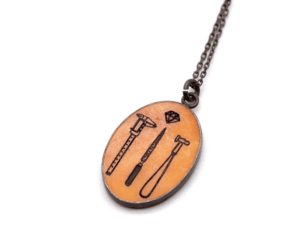
Missing from this list is the dichotomy between tools and sculpture. This is important because this exhibition is not just an entrance point to Stofer’s creative headspace but a focused interrogation of the concept of tools and tooling.
Tooling has aroused recent attention within applied art theory. Craft theorist Glenn Adamson wrote a short essay called ‘Tooling up and tooling down’ in Eighteen proposals, a catalogue for Royal College of Art Ceramics and Glass graduating students (May 2010) in which he positioned ‘vertical movement within the single meta-field of tooling’ as a potential post-disciplinary strategy. This represents an alternative approach to the current popularity of lateral movement across disciplines (for example, a jeweler engaging with sculpture), and might involve deliberately using the wrong tool for the job, or conflating different tools together. An example of this ‘tool-as-art’ genre is Tim Hawkinson’s Signature (1993) that combines old school chair with winged platform, a ballpoint pen, a roll of cash register tape and motorized elements to make a contraption that endlessly reproduces his own signature. The chits of paper pile up, making an obvious statement about artistic authorship, but the work also provokes an enquiry into the relationship between art object and tool.
Critical examination of tooling in art practice engenders a post-disciplinary future where craft takes centre stage, due to applied art practitioners’s closeness to the tools they use. But serious discussion of the role of tools in practice is held back by the romantic and often spiritual way in which makers describe their tools.
Stofer’s exhibition Walk the line does not indulge in such an infatuation with tools. Instead there is a playful provocation of the tool as sculpture. Paintbrushes with spoon ends are standing in jam jars and stained tin cans; a jug is made from a one-pint plastic milk vessel and an orange juice carton; nails have tiny ornamental heads on them that would make them frustrating to use in any DIY project; buckets become chairs; a trowel has a candle for a handle. Tools are twisted, made ridiculous and denied of function; conversely found objects are made into tools.
Many of Sofer’s works fall into the Duchampian tradition of the assisted readymade, taking a found object and doing something extra to it. The Swiss Gruyère cheese is not asking to be judged as an art object by itself but is shaped into a cross, parodying traditional jewelry iconography. At the end of the corridor is Off my trolley, a wooden cart laden with what appears to be shards of the artistic process – cigarettes, graffiti, smears, half-used paint tubes and plastic cups. But each piece is constructed by hand: what appears to be a stubbed cigarette, for example, is actually made of metal.
This is more than just an effort to ‘tease out something new and meaningful from the old and unwanted’ as Fiona Rattray put it in her review for Crafts magazine (n.224, May/June 2010). This is a playful, proactive appropriation of found objects that are shaped into functionless and functional tools/art. Moreover, Stofer deceives the audience into thinking that he has only used readymades, when actually he has employed craft skill to make things look like readymades. There is a deception at play, showing how makers can exercise magic on materials to trick viewers – an exploration of craft as ‘crafty’, or cunning.
The title of the show recalls the famous Johnny Cash song ‘I walk the line’. Of course we could explain this choice of title as a reference to treading the fine line between all those dichotomies mentioned earlier – the treacherous path of the maker between art and craft. But there is an alternative reading. Cash often recalled that when composing this song in the 1950s that he wanted to use a snare drum. However, this instrument was unpopular in country music at the time so instead he put a piece of paper in between the guitar strings and the fret board to create his own ‘snare drum’ effect. It is perhaps this more obscure reference, the making of a tool specific to need, that we should look to for in a more provocative reading of the show.
July 15th, 2010 08:07
Dichotomies in Objects: Contemporary South African studio jewelry from the Stellenbosch Area is an exhibition comprised of jewelry artists from Stellenbosch, South Africa. The artists have been selected by myself (Lauren Kalman) and Carine Terreblanche, a jeweler and educator from Stellenbosch. All the jewelers in the show are affiliated with Stellenbosch University – one of the only schools in South Africa teaching conceptual approaches to jewelry making – as faculty, students, lecturers or alumni. They have been selected to represent a diverse cross section that reflects a variety of approaches, from highly conceptual practices, tongue-in-cheek kitsch, to more poetic material investigations of form. The jewelers in Stellenbosch are trained with a high technical proficiency and a strong conceptual understanding, with some investigating jewelry using contemporary media, such as digital video.
The exhibition highlights collections of five to ten pieces per artist. By having collections from each jeweler it is my hope that the viewer will be able to see trends, themes and deviations that permeate both individual bodies of work and the group as a whole.
Currently the exhibition is on at Velvet da Vinci in San Francisco, and traveling to the Ohio Craft Museum in Columbus.
The exhibition was conceived in 2008 while I was an artist in residence in the Jewelry Department at Stellenbosch University. During my stay the department was installing the exhibition Inventions at the Gold of Africa Museum in Cape Town. I was impressed by the quality of the work and began to collaborate with my co-curator, Carine Terreblanche, to bring a exhibition of South African studio jewelry to the United States. The catalog was made possible through funding from the Society of North American Goldsmith, a co-sponsor of the exhibition.
The primary goal of the exhibition is to introduce American audiences to the thriving contemporary jewelry tradition in South Africa. It is my hope that this exhibition will break stereotypes and assumptions about what African jewelry is or can be. Specifically that African jewelry comes from both traditional methodologies and conceptual practices. With critical discourse in the contemporary jewelry field focused on the northern hemisphere it is my hope that this work will feel new and invigorating.
Cross-cultural exchange allows for the expansion of ideas and experiences. Exhibitions such as Dichotomies in Objects are one way to promote the transfer of ideas. They broaden our understanding of the world and help to cultivate more globally minded and socially aware individuals.
I had the opportunity to see work by many of the artists first hand, and the remainder were selected by Carine Terreblance. The goal was to find work that was visually challenging and experimental or conceptually driven in nature. Dr. Lize van Robbroeck, Associate Professor of the Department of Visual Arts, Stellenbosch University, was selected to write an essay for the catalog as an expert in the field of visual arts in South Africa.
In this case it is a method to curate a group of objects. By setting a constant criteria the work can be compared and contrasted within a fixed set of parameters. One might find that the work is very much South African in character or perhaps that nationality is no that cohesive a label. That being said, it is interesting to consider how factors related to geographic location – like landscape, climate, and culture – might impact the process of making.
That remains to be seen.
July 9th, 2010 09:07
It’s an important moment in the history of contemporary jewelry design in New Orleans. There are only a few venues for contemporary work of this nature in the city so it’s a remarkable moment when one of the city’s prominent museums is willing to celebrate work from the field of contemporary metalsmithing.
Jan Katz knows her stuff. She’s been a fan of contemporary jewelry, collects it and knows the current maker scene. She selected an appropriate range of artists relative to experience, reputation and influence from the field and, as a result, the show makes a vigorous statement about the quality and character of the artists working in the medium today.
I was a bit disappointed at the installation site for the show. It takes place in the museum store, which is a nicely designed modern space, but not as nice, nor as important, as many of the museum’s primary exhibition halls. But, in light of the restricted budgets that most organizations and galleries are working with to mount exhibitions these days, displaying the work in four pullout drawers (the top two side by side, which had glass tops) was adequate, just not as celebratory as you might hope for. In support of that decision though, Katz’s very helpful sales assistant is happy to remove any of the pieces for closer inspection. And all the work is for sale, so maybe the store is a better exhibition space for everyone concerned.
To their credit as well, at the opening on Thursday 21 April, in between Jazz Fest weekends, models walked around the museum acting as moving canvases, with exhibition brooches displayed from collar to hem. Of particular note is that, despite the lack of funds for a catalog, they made the inventive, creative decision to enlist the aid of artist Fredrick Stivers, who hand drew a lovely illustration of each piece in the show. His work was employed in the design of a simple broadside layout catalog in B & W. This piece alone is remarkable. A unique document of the event and, in my estimation, a document that is collectable in it’s own right.
Anyway, here are some reflections on the work of each jewelry designer in the exhibition.
Linda Threadgill: really snappy copper compositions. Lots of kinetic energy. Inventive shapes and connections.
Biba Schutz: I want to see these pieces BIG on a wall somewhere. Biba’s imagination is on the threshold of the fifth dimension!
Bob Ebendorf: Ebendorf appears to be channeling Rauschenberg, Klimt, and Cornell all at the same time! And the eclectic fine mesh personal vocabulary filter he strains them through produces iconic work. And the pieces he sent for this exhibition are in addition really ridiculously low in price. What were you thinking Bob?
Valerie Mitchell: Wow! Valerie really stepped out into a new dimension for these pieces. I’d love to see the rest of this group cause’ these enameled, electroformed shapes are spectacular! She is obviously experimenting and pushing her personal envelope in new and exciting directions. You go girl!
Rachelle Thiewes: She is always pushing the edge, and always successfully! That’s what is so unnerving about her work, damn it! Brightly painted circular motion steel forms with brilliant magnetic discs for securing the pin to fabric.
Marjorie Simon: Most of us know Marjorie for her torched fired enamel work. But the pieces she sent for this exhibition are revelatory and exceptional. So even if she dug them out of a personal archive of work they are still delicious in their creativity and structure.
Kiwon Wang: We know that Kiwon is the Pearl R Us designer of record. So it was cool to see here actually systems bashing her silver structural work (with pearls) with her also signature use of newspaper (with pearls) in one of her two pieces.
Sondra Sherman: Black is beautiful! These pieces from Sandra’s current body of work are an exceptional exploration of steel and enamel.
Marlene True: Steel, gold, delicious apparently fragile elegant forms. Luscious!
Joyce Scott: Hey, make a face Joyce! No, not that face, the one with BEADS! Get these prototypical Joyce Scott pieces NOW!
Linda Darty: Queen of enameling, flower goddess, delicate lovely enchanting pink!

Anya Pinchuk: She is really working it! An awesome extrapolation of polymer clay, crystals, wood. Three pieces, all completely different, all completely cool!
Sandra Enertline: Did you know that Sandra drills everyone of those tiny, tiny holes by hand, no techno tricks. It’s INSANE but beautiful, elegant and full, absolutely stuffed with metal umami!
Arthur Hash: Only one piece but a clear demonstration of Arthur’s continuing interest in exploring the possibilities of technology applied to jewelry design.
Joanna Gollberg: Space is the place, Johanna! Suspended stones on a course to somewhere, most likely on your lapel!
Kathleen Brown: The butterfly piece is deceptively light, precise and enchanting. Kathleen is always experimenting. Her very precise vocabulary reveals itself delicately in these pieces.
Julia Barello: The floating window escape, with x-ray lenses, another world awaits.
Heidi Gerstacker: dude, let’s get minimal – thin, balanced, sharp.
Marcia McDonald: Marcia, we love you even though, invited, you weren’t here in this show with us.
Pat Flynn: Pat’s work drives elegance strait down the center of brilliance. His evolution from historic the inspiration imbued in hand forged nails through those objects delivered to these exquisite objects is a true travel adventure.
Don Friedlich: Donald has carved out (literally and figuratively) his own niche in the pantheon. Slate, then glass. What’s next? Remember the Clothes Pins? Really inventive. (Ask him about them.)
Susie Ganch: Absolutely the most cutting edge piece in the show! Susie is kicking it big time for inventive use of materials and techniques. Buy this work NOW – it’s going to be immensely important.
Thomas Mann: You don’t really expect me to review my own work here, do you? You’ll have to be satisfied with my admission that I am addicted to beach combing for stones!
July 8th, 2010 06:07
Should you find yourself in Santa Fe, New Mexico, during the next four days we suggest you make a visit to SOFA West and check out the high-end craft and contemporary jewelry on display from 8-11 July 2010. If the only sofa you have ever heard of is a kind of couch, let AJF be your guide to one of the major institutions of the American craft scene. According to the SOFA website:
SOFA Chicago has been running annually since 1994, and was joined by SOFA New York in 1998. SOFA West: Santa Fe is the new kid on the block, now in its second year. (You can find out more about SOFA by clicking here.)
Contemporary jewelry lovers attending the fair should look out for ‘My hands are my favorite tools: conversations with four jewelers – Robin Waynee, Kenneth Johnson, Pat Pruitt and Cody Sanderson’, taking place on Friday 9 July 2010. The organizers are branding this event as ‘A panel discussion on Southwest jewelry today featuring four artists whose work is contemporary and individualistic, but at the same time a continuum of the art inspired by the vast cultural and natural landscapes of the American Southwest.’
We asked AJF gallery member Charon Kransen if he could tell us a little bit about why he attends SOFA West, and what he was intending to show this time around. Here’s what he told us:
AJF will be publishing a review of SOFA West: Santa Fe on our website in the next month, so if you want to know more (including the color of the Charon Kransen booth), keep watching this space.
June 24th, 2010 09:06

I have many times visited the question, ‘why jewelry?’ The choice to make small, wearable, durable objects rather than large, impermanent, edible, inhabitable or otherwise different objects is one I think about a lot. The impulse to go up in scale has been stronger and stronger recently, and having finally made the shift in this collection to including wall pieces, I find a refreshing new question appears: ‘which jewelry?’ And, ‘what else?’. If I eliminate the requirement that everything I make must be small and wearable, an interesting thing happens to all the ideas: some of them naturally stay in the category of jewelry because they are entirely appropriate to that category, and the rest find their way to other categories, the overall effect being a feeling of space and possibility (in the jewelry and everywhere else) that I’ve never experienced before.
I’m reminded of a swimming area roped off on the surface of a lake. The rope sits on the surface telling people how to think about the water, but the water itself moves according to its own natural laws. I have always experienced categories as dams . . . but I think they’re really ropes.
The pieces in this group fall mainly in two directions. Half are driven almost entirely by flat images in black and white and are minimally constructed. The small features in gold and enamel added to these came with the choice to make these into jewelry and not something else, like small leashes to prevent them from running off. The rest of the pieces are dense, heavy faceted and stacked objects in wood whose surface interest exists mainly in relation to their structure. I worked on both series at the same time, going back and forth and using the contrast in process to lead me to each next step.
The flat pieces are made by scratching through white industrial paint down to black oxidized steel underneath. The feeling of drawing with sandpaper and a knife is totally different from that of drawing with a pen. It takes both arms, it makes a sound, it creates dust. The slight distraction of the physical work involved is just enough to keep me from overthinking what I’m doing – it’s the perfect way of tricking myself into drawing from my actual present experience rather than trying to corner distinct images and get them ‘right’. These start as large panels which I work on in all directions, and I know when I begin that they will get chopped up according to the feelings of a different day, when I skim them with a small frame looking for places where a small interaction of shape and line suggests a tension or excitement or sadness that fits what’s on my mind. For me, this secondary extraction feels like something between photography and cartography. The full frame implies something partially captured, rather than created to fill a space, and the choice of which areas to magnify and set apart takes a judgment on my part similar to that of a mapmaker deciding what gets an insert: which parts of this city do people care about the most?
The wall pieces made with this same drawing process are constructed exactly the same way as the brooches (minus the pin mechanism) and they occupy the wall in much the same way as the brooch sits on the shirt. I’m finding it fascinating to consider what changes, and what doesn’t, in that migration to the wall.
The evolution of the wood pieces is similar to that of the drawings. I begin from a table full of forms, some of which have gone through some transformation outside my studio (sawmill, construction, fire) and some of which I have altered with my own tools. I select and trim and paint and combine, registering my own response as I add and subtract parts to arrive at the small ‘situations’ which I eventually pin together and fasten with steel.
When talking with people about my work the conversations almost always revolve around suggestion and interpretation. The compositions are resolved but the narratives are open-ended, left so intentionally. Every viewer has a different story, a different perception of the scale, the subject and the emotional content; I listen for these responses and am continually surprised by them and by the range and intensity of their expression. Each of these new observations adds a layer to the content of the piece. Though the memory of my own impulse in creating it will always be there, I rely on that impulse only as long as it takes to finish the making, after which I would rather talk about someone else and something new. I am not interested in creating a vehicle for one idea or in bolting a single story into place. I am curious about perception and other people and am describing my own experience as a starting point. From there, the conversation is the reason for the piece.
June 19th, 2010 11:06

While we here at AJF like to think of ourselves as particularly contemporary in our jewelry tastes, we can’t help but admit to a weakness for the well-presented antique jewel. Our enjoyment of The Tudors on DVD has certainly been enhanced by all the jewels that adorn the heaving bosoms of King Henry’s court, and more than once we have felt a warm glow as the jewelry on Antiques Roadshow is identified by the experts as worth a small fortune. The past, as someone once said, is another country, and historic jewelry represents a diverting holiday from the usual gems that are the focus of our attention on the AJF blog and website.
In light of all this, we were pleased to discover that Historic New England, which is dedicated to preserving the heritage of New England in the United States, has recently created an online exhibition which explores the rich history of jewelry in Maine, New Hampshire, Vermont, Massachusetts, Rhode Island and Connecticut. Prosaically titled Jewelry at Historic New England, the exhibition features some of the more than 2500 pieces of personal adornment that the organization now holds in its collection. (To visit the online exhibition, click here.)
The exhibition is accessible through two portals, one of which divides the objects into a ‘Style & Design Timeline’, and the other which explores the collection through a variety of ‘Themes’. Whichever way you choose to access it, the exhibition is both lively and rich with historical detail. Here, for example, is what you discover in the section titled ‘Seen but not heard: Jewelry for children’:
Or this, from the style guide to the period 1850 to 1890:
Well illustrated with a range of historic and contextual images, as well as photographs of the jewelry itself, this is an impressive resource that is well-worth a visit for anyone with an interest in historic gems, and a good introduction to the history from which contemporary jewelry emerges – and to which it reacts in various ways.
June 16th, 2010 10:06
A late night last October doesn’t feel so long ago. In the studio, burning the midnight oil, polishing off my online submission for Talente. At the time it felt like one of those lotteries – ‘gotta be in to win’. I had only recently realized I was actually eligible (you have to be 30 and under). Little did I imagine that five months later I’d be walking the snowy streets of Munich.
As an emerging jeweler, being selected for Talente is a tremendous encouragement and endorsement. It suggests someone somewhere thinks you might have an inkling of promise. So I was incredibly grateful for the opportunity, from Creative New Zealand, the national arts funding body, to attend the show in person and experience this jewelry pilgrimage. The week of events was one of exhilarating (and slightly dizzying) full jewelry immersion. Aside from Schmuck and Talente there was a multitude of satelite exhibitions, showcasing a work from many countries. As a result people had journeyed from all over Europe, the UK, USA, Australia and our six-strong contingent all the way from New Zealand.
Talente was naturally our first stop in the week of events. To provide a bit of background, Talente is organised annually alongside Schmuck by the Handwerkskammer für München und Oberbayern. Both are part of Munich’s International Trade Fair. Located at the outskirts of Munich, the trade fair occupies a sprawling former airport and includes everything from plumbingware to specialty sausage. Needless to say most of us never left Trade Hall A (the handcrafts hall).
Unlike Schmuck, Talente focuses on young and emerging talent from a range of craft and design fields. This includes jewelry (which always has a strong presence), ceramics, glass, furniture, lighting design, textiles, fashion, product design and technology. This year 99 entries were selected from the 400 submissions, representing 24 countries. The diversity of work in itself is impressive – from vessels, lamps and furniture, to a boat, a burial urn and almost everything in between. I would estimate close to half was jewelry.
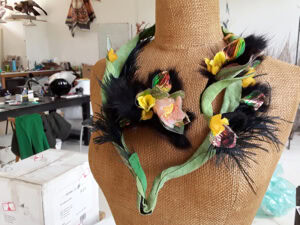
Memorable examples included the hyper-realistic fake flower corsages of Jihye Lee (South Korea), the tack-a-rama fake nail and LED flower ensembles of Lisa Juen (Germany/China), the subtler stone and photograph assemblages of Berta Riera (Spain), and the lightweight realistic boulder brooches of Barbara Schrobenhauser (Germany). In truth, there was so much to see in Talente alone (not to mention the neighboring Schmuck, Exemplar and gallery shows) that it was a little overwhelming. Despite visiting three times, I was relieved to have the color catalogue to go back to at a later date.
With the week’s packed lineup, I was keen to see different approaches to exhibiting jewelry. In Talente and Schmuck, the challenge of displaying such variety understandably meant the exhibition design was fairly innocuous. The works were laid out in well-lit glass and steel cabinets, or hung from the steel partition system – tidy industrial design but more in the spirit of the trade show it was part of.
Many of the satellite exhibitions, however, were sited in more unusual locations or featured inventive displays. One of the most experimental shows was Eternal Shine – it’s not a Pony, by four current and former students at the Academy. This was a kaleidoscopic treat with mirror plexiglass display boxes hung on the grungy walls of a painting studio. These boxes were arranged at various heights that forced you on your our tippy-toes or demanded you squat down for a good look. Their entertaining optical effects certainly held people’s attention but, surprisingly, without detriment to the jewelry. Melanie Isverding’s enameled structures and Nicole Beck’s stitched body-part assemblages were particularly memorable. The mirrors were quite pragmatic, offering 360-degree view of the pieces, and, if anything, the ambient visual noise moved you in to focus on the pieces.

The overall jewelry highlight was Karl Fritsch’s revival of the Pinakothek der Moderne’s contemporary jewelry collection. (To read more about this exhibition, click here.) The collection itself was awe-inspiring – certainly a contemporary jewelry hall of fame – and I admired the fact that Fritsch curated this volume of work without resorting to museum conventions of logical groupings and labels. Arranging works into meandering lines in a seemingly random order, Fritsch successfully put the works into dialogue with one another (reflecting, I like to think, the vibrant diversity of the contemporary jewelry field). Rather than focusing on individual works, their close proximity drew attention to the connections between them. The lack of labels deemphasized who-made-what, though it was still fun to play a guessing game wrestling with the oversized list of works.
Other memorable shows included the Dialogue 8 show (UK) in an old foundry, spatialPalace (Estontia) in a cemetery, and the walls of shirts in Nicht dass du mir von der bluse fällst. Interestingly, the work I enjoyed most the often was part of more conventional displays.
Glancing back through my journal, I see I went to twenty-two exhibitions that week, and many of them twice. This meant I was shifted from my usual role of maker/wearer to the full-time role of jewelry viewer. On one level, seeing the jewelry in person (without the texts to dictate our response) permitted appreciation of craft for craft’s sake – enjoyment of the material and formal possibilities of jewelry. On another level, it made aware of the particular kinds of interaction a viewer has with jewelry. Within the tight schedule, many works were consumed at a glance while others stood out because they demanded prolonged attention. Pieces that commanded a second look, included Fabrizio Tridenti’s complex structures (in the Pinakothek der Moderne), Bettina Dittlmann’s intricate wire works (at Galerie Isabelle Hund and Danner-Rotunde) and Mirjam Hiller’s intriguing folded constructions (at Galerie Stühler). For me, these tended to be complex forms that resisted a quick glance. They somehow confused my eye, forcing me spend time, running over their surfaces and structures with a visual sense of touch. It made me wonder how jewelry (or an exhibition such as Eternal Shine) might intentionally prompt this haptic way of looking to slow a viewer down, and hopefully compelling them to wear it.
Exhibitions were not the only places to see jewelry. Teeming as Munich was with jewelry devotees, the week was equally a spectacle of jewelry wearing. Each morning in the hotel we would anticipate what the collectors and critics might be wearing while doing our own jewelry swaps for the day. Over the week, Fran Allison (New Zealand jeweler and Talente mentor) and I documented some of this jewelry-in-action which you can see on our photo blog Moveable Feasts. (To visit this blog, click here, and feel free to contribute more photographs.) Being surrounded for a week by other jewelers, students, gallerists, critics and collectors made you really feel part of a larger international community.
So, how does one cope with seeing so much great jewelry in one week? For a start, it prompted a bit of soul searching. Mike Crawford, a fellow New Zealand Talente participant and glass artist, raised this issue. At the Pinakothek der Moderne he poignantly asked, ‘How does it make you feel, seeing so much amazing work? Is it totally discouraging – does it make you want to give up?’ He had an important point. At the beginning of our careers, how do we position ourselves in relation to these pinnacles of the field? Do we aim to attract the attention of European institutions and collectors, striving to have work shown alongside the grand masters? Do we succumb to Munich’s magnetic pull and try for the Academy? What are the alternatives?
A heartening answer seemed to lie in the radical exhibition of students from Maastricht. Their portable ‘jewelry in a bag’ format enabled the group to piggyback on the opening at the Pinakothek, usurping an audience in the process. This was echoed by Willy Van De Velde, a jeweler who drove his van over from Belgium and parked outside another show as a mobile gallery. These actions seemed an inspiring message for emerging jewelers: You don’t need to rely on institutions for public exposure. Do it your own way! It really drove home that our practices must extend beyond the production of jewelry to the production of wearer/audiences.
Otherwise, there comes a point when seeing so much jewelry simply makes you SICK OF SCHMUCK. The remedy, care of the students of the Munich Fine Arts Academy? A night of drunken jewelers dancing to German techno.
Surprisingly, after this marathon week, I wasn’t completely sick of schmuck. I still had stamina to visit the Amsterdam galleries and Galerie Marzee and was itching to get back to the bench.
June 6th, 2010 06:06
Here at AJF we recently came across an interesting interview with Gabriel Craig, one of the jewelers featured in Lena Vigna’s exhibition Adornment and Excess: Jewelry in the 21st Century. We have a particular interest in this show, since it was one of the projects that received a $2500 grant from AJF in 2009. (You can read more about the grant by clicking here.) Vigna’s exhibition explores the way in which some contemporary jewelry is articulating a perspective about the historical connection of adornment and wealth, luxury and excess. As she puts it in her catalogue essay:
We asked Vigna if she could provide us with some insight into the exhibition themes, and you can read this text on the AJF website by clicking here. As for the interview with Craig, here’s a sample to wet your appetite.
You can read the entire interview by clicking here.
May 13th, 2010 01:05
Here at AJF we have spent a bit of time talking about Schmuck, the week of jewelry-related events that takes place in Munich every March. (You can read American jeweler Doug Bucci’s report by clicking here and here, and our recent report from Australian jeweler Zoe Brand by clicking here.) In 2010 one of the notable happenings was the series of exhibitions dealing with contemporary jewelry at Die Neue Sammlung (the International Design Museum) in Germany. (To visit the museum’s website, click here.) The big news was German jeweler Karl Fritsch’s exhibition New in the Danner Rotunda, a purpose-built wing in Die Neue Sammlung’s Pinakothek der Moderne (the Munich branch of the museum) funded by the Danner Foundation.
According to the museum’s publicity:
You can view a video of the opening of Fritsch’s exhibition at the Pinakothek der Moderne by clicking here. And, along with images of jewelry featured in the exhibition, there are a number of images of the exhibition throughout this post that illustrate the sometimes extreme way in which Fritsch has curated (and installed) his survey of contemporary jewelry practice.
We asked Fritsch if he could give us some insight into the way he approached his curatorial duties. He responded: