May 30th, 2010 08:05
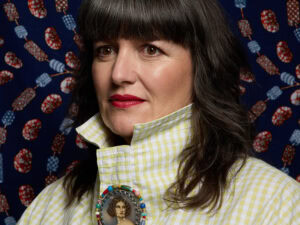
Born and raised in Matsue in rural Japan, Mari Funaki came to Australia in 1979. Expected by her family to make a traditional marriage, she found a new life in Australia while travelling the world as a young woman, staying in Melbourne to become a leading member of the city’s cultural renaissance in recent decades.
Funaki’s story is exemplary of how shifting country and culture can unleash an individual’s potential. ‘If I had remained in Japan, I would never have been doing what I am doing now. In Australia I learnt freedom to express myself and to build my own identity.’ Australia is composed precisely of such stories of transplanted lives and talents.
In her late thirties Funaki found her true path in gold and silversmithing. She retrained at RMIT and plunged into the community of makers centred on the university, including a traineeship with Marian Hosking in 1993. From then, Funaki was central to Melbourne’s vibrant art and design, not only as a maker but as an enthusiast and patron through her gallery, tirelessly promoting contemporary jewelry.
The crisp excellence of Funaki’s jewelry was immediately recognised, and from her graduating year was included in major national and international exhibitions, museum and important private collections, and awarded important prizes both in Australia and overseas. Her approach was distinctive, with a repertoire of elegant angular black steel and fine gold brooches, rings and bracelets established in the first decade; this gradually expanded to include complex containers. These sprightly forms sometimes resembled insects or leaves, but were often simply analogues of physical principles, always beautifully resolved.
Funaki’s approach was intuitive, firmly rooted in Japanese ways of seeing: ‘Packaging is one of the most recognisable characteristics in Japanese culture. The box is not just to contain something, but it is used to present something, to treat it with respect and add an air of anticipation.’ At first the containers sheltered hidden spaces, but over time became freer, more experimental, with internal spaces discernible only through close observation; new shapes suggested the built environment. Recently, some works were scaled-up to make large sculptures. Working with a personal vocabulary, she prized the way each piece suggested emotional states or memories. Refined, elegant, impeccable, her work distilled observation into beauty.
Importantly, Funaki created Australia’s most important private gallery for contemporary jewelry. Passionate in her commitment, she saw that Australia’s contemporary jewelers needed a showcase and opened Gallery Funaki in 1995. This tiny bolt-hole is one of the world’s best addresses for contemporary jewelry. Funaki’s vision was international: she wanted Australian work seen in the broadest context, showing Europeans Otto Künzli, Karl Fritsch and Nel Linnsen, and New Zealanders Warwick Freeman and Lisa Walker, together with leading Australians such as Hosking, Carlier Makigawa, Sally Marsland and Julie Blyfield. This was a symmetrical dialogue: Funaki tirelessly organised Australian exhibitions abroad and welcomed many artists to her adopted country.
Mari Funaki finally succumbed to the breast cancer she battled so valiantly. She is survived by her beloved mother Mitsuko and brothers Masaya and Takuya Funaki of Matsue, Japan, her friends in the Australian and international artistic communities, and the legacy of support for her fellow-artists. She died at the height of her powers, working on new sculptures. On 6 August the National Gallery of Victoria will open her solo exhibition at its Federation Square building, and later this year the National Gallery of Australia in Canberra unveils a two-metre high sculpture by Funaki, commissioned to celebrate opening of its new galleries. And in her North Carlton garden, Mari Funaki’s cherry tree awaits its next spring blossoming.
May 29th, 2010 07:05
Contemporary art? Yes! In México we have the biggest contemporary art collection in Latin America, owned by the Jumex Foundation. (To visit their website, click here.) Contemporary jewelry? What? It was the first time for many people to even hear the term. It was even more shocking for jewelry designers and crafters attending the Gray Area symposium to discover there was something called contemporary jewelry. Didn’t the word contemporary mean ‘something of the moment’?
The symposium lasted five days, full of activities throughout the days that ended either in openings, dinner parties or even on one occasion danzón. (To find out more about this style of dance, click here.) The Gray Area involved approximately 44 lecturers from Europe and Latin America, four round tables, one worktable, twelve openings in different gallery spaces, and one workshop. And of course the public who came from around the globe. What a week!
Manon van Kouswijk opened the symposium with the idea that ‘jewelry can be many things but not anything can be jewelry’. Then came Caroline Broadhead, who talked us about our senses and the way in which the visual sense for the viewer is completely different from that of the wearer, who has already activated different senses. Clemencia Plazas was next, talking about the American (as a continent) way of seeing through metal and through history. After lunch we heard something about the use and meanings of materials for different cultures, to end the day with what for me could define the whole experience of the Gray Area symposium: ‘What does jewelry mean to us?’
For many people attending the symposium this first day was shocking. Many of the audience considered themselves as designers, some others just crafters or artisans and some others contemporary jewelers. The discussion heated up the auditorium at the Biblioteca Nacional Jose María Vasconcelos where the symposium was held, when some felt their professions attacked by the labels and the tags. International participants came mainly because they were either artists showing at an exhibition, lecturers or interested in contemporary jewelry. But for many Mexicans it was just a jewelry symposium. Many of the Mexican crowd couldn’t understand the differences, so out again came the discussion of: ‘but I have to sell, and therefore it has to be wearable, affordable, commercial, likeable and why not beautiful!’ A never-ending discussion. Valeria Vallarta, curator, organizer of the symposium and president of the Otro-Diseño Foundation said to us: ‘We won’t get anywhere with this discussion, the eternal question keeps on. What came first, the egg or the hen?’
Day Two started with Ruudt Peters talking about his amazing work. This was followed by a teleconference with Mónica Gaspar, who was saved from some difficult technical issues by Valleria’s other half, her husband who really knew how to run the show in all technical aspects. Monica talked about jewelry as a metaphor, and then came Manon Van Kouswijk who explained that technique for her is a means to get somewhere else. After a short coffee break Jorge Manilla and Marta Hyrc talked about their own work. Marta discussed substitutions in objects, and Jorge about his migration to Europe leading him to understand his own history from a different perspective, and creating his own narrative through objects and materials. Afterwards came Beat Eisman who expressed her personal view about when she was living as an exchange student here in México, and Mirla Fernandez who discussed her body consciousness with her latex pieces. After lunch we heard the exciting presentation of Jiro Kamata, who made everybody laugh after he revealed the ‘behind the scenes’ of the Tessa rings. Before the round table of the day we heard Xavier Andrade’s lecture about how jewelry is inserted in multiple social relations.
At this point in time let’s be honest, if you are not in this contemporary jewelry business the artists presentations during the day could have been shocking. I mean come on: a latex necklace? a ring made out of kissed tape? a bone necklace? or a lingam piece? The round table wasn’t that packed which made it less heated because many of the attendants had already made up their minds about what kind of jewelers they were (or at least thought they were!). It was about the role of the academies in the encouragement of formal and conceptual experimentations in jewellery. The discussion was more about the lecturers talking about their own experiences and strategies in their schools: the Escola Massana in Barcelona, Spain, the Academy of Fine Arts in Havana, Cuba, UNAM in México city, the Rietveld Academy in the Netherlands, and Centro in México city. As for my own experience in this field I think we first need in schools a more conceptual and abstract way of thinking. We have to learn how to question ourselves in order to seek for answers. Our country – and indeed all Latin American countries – are rich in artisans, crafts and culture. We just need to think differently.
Day Three was a mixture of everything. We heard Walka studio talking about their experiences in migration and how migration is transformation, then we heard Sarah O’Hara explaining her laser technique, and then came Felieke van der Leest talk about her interesting zoo. Nuria Carulla showed not only her work but also many artists, which she has supported and trained in Colombia. Nanna Melland talked about her almost surgical work with body parts or pieces. Ximena Briceño talked vey little about her personal work and more about the history of filigree. Francisca Kweitel and Estela Saez Villanova talked in a very informal way about their personal relationship and personal work, living in different continents but sharing the same passion. Miguel Luciano talked about his Puerto Rican-rooted point of view living in the USA. The round table was about management and promotion of contemporary jewelry in Latin America. Mónica Benitez got a lot of cheers and attention among the jewelers who already know her, as she represents the biggest silver industry in Mexico, Industrias Peñoles. Many of the attendants found finally a place as she talked about the space and promotion this industry gives to young and elder jewellery designers. For many it was finally talking about reality, more than talking about ‘dreams’. It was the most tangible talk they had experienced up to that moment.
Day Four, and the last day of lectures, a number of which were rescheduled. Jurgen Eickhoff talked about the history of Spektrum Galerie in Munich with its ups and downs. Cristina Filipe then explained the PIN project and the welcome they had in Portugal. Liesbeth den Besten talked about her private passion, the art of collecting wearable art and art not as qualifying but identifying. Then we had two round tables. In the first one we had the name Gray Area explained to us as ‘a border in-between, two or more things that are unclearly defined, a border that is hard to define or even impossible’ (Wikipedia). I would say this was the most relevant explanation not just of the name of the event, but the description of the attendees mood. Many of participants were in a ‘gray area’ state of mind and many others were not, but at least they understood what this was about. They seemed to be clearer about what they were or where wanted to go. People from different countries started to mingle, exchange e-mail addresses and share their trades. A Mexican jeweller called Lorena Lazard started gathering information to create a directory of Mexican jewellers.
The mood was very joyful specially when Valeria gave her wonderful personal talk and placed herself in an Italo Calvino story from his book Invisible Cities. My personal view is that this person whom I just met and was in physical pain at the moment galvanized the whole audience with her reading and her presence and managed to have the people giving her a standing ovation for the whole symposium. She managed, for the first time ever in México, to present – not only to the participants at the symposium but to a big audience through galleries, art spaces and even in a candy shop – what contemporary jewellery is. The day ended first with Ricardo Domingo’s talk about our own DNA search for a perfect commercialization, giving many examples, but specially answering many enquiries people had. Some had already been in his course and some others just signed in. The last round table was about the position of jewellery in a truly global context.
Day Five was a work table divided into different themes. Some of the tables were a little bit of a mess, as it was difficult to communicate in different languages, but in the end it was the first task to accomplish the organization of all these active viewers into groups, to talk to each other about our own experiences outside of the spaces of socializing.
All in all it was a magnificent experience. Not just an eye opener but also opening doors to an international level which is always very attractive, and is now spreading into new projects here in Mexico where the contemporary jeweler will look and search and work and move and act.
May 29th, 2010 12:05
The New Jewelry doesn’t look so new twenty years on but this book by Peter Dormer and Ralph Turner remains a good source for serious discussion of what makes art jewelry different from other kinds of jewelry. In three sections the book describes the major themes of contemporary work. Abstract Jewelry begins with Hermann Junger and David Watkins but includes many lesser known artists (at least today not so well known) that created very exciting work. The Figurative section includes early work by Bruce Metcalf and Manfred Bischoff. The final section of the book deals with Jewelry As Theater. Experimental pieces like Pierre Degen’s Large loop seem from a more revolutionary time but Otto Kunzli’s 1980s pieces show how he anticipated many of the ideas that continue to inspire artists today. It is interesting to note that although many jewelers featured in The New Jewelry are still producing work many others are not. The more radical aspects of the New Jewelry movement petered out long ago while other forms evolved into the varied field we know today.
The British authors include a number of American artists in the book but the focus is primarily European. The New Jewelry remains valid because of the perceptive and critical writing of the authors. There are biographies of the featured makers and a short section on the important role of galleries and museums in the field. Although out of print the book can easily be found online at Amazon and Powell’s.
May 28th, 2010 06:05
I had never spoken to Ilse Marie Erl or read anything about the brooch before, but I sort of knew that the concrete came from Mt Eden prison in Auckland. Straight away I liked the contrast of all that a prison conjures up and the respectable front diamonds have but often a criminal life lies behind their provenance. Like the ‘blood diamond’ – good to be reminded of where ordinary or intimate items in our daily lives come from. Every time I pin on the brooch, even though the diamond is a mere dot, Sierra Leone always flashes through my mind for a brief nanosecond, reminding me that I lead a privileged life. Since I’m not at all fond of the ‘Michael Hill’ school of jewelry but somehow cannot resist the traditional elements of jewels, like pearls, emeralds, rubies and diamonds, the brooch was a legitimate way of having it all. The photograph does not do justice to the diamond. It is very tiny and quietly twinkles away like no other stone can.
All my concrete work with aggregate is from the new Mt. Eden prison in Auckland. I glue the diamonds in to enhance the quotidian/precious, traditional/contemporary contrasts or binaries. It is a discussion of preciousness, in the literal and in the lateral sense: there is a very limited amount of this particular concrete available, there is a history attached, where lies the preciousness in the ordinary? Why does something become precious? How? Further, there are associations along the line of prison, precious, criminal, blood diamonds, etc. And last but not least: with my entire concrete jewelry investigation I tried – unsuccessfully – to seduce Kiwi men into wearing more jewelry.
May 21st, 2010 03:05

Just a reminder to all you young, talented and yet uncomfortably poor contemporary jewelers out there that it is time for you to be applying for AJF’s EAA. FYI for those of you saying WTF at all the acronyms, the Emerging Artist Award is a $5000 US prize given out by Art Jewelry Forum each year to a contemporary jeweler at the beginning of their career. You must have competed your academic or professional training, have been out of school for at least a year, and not yet achieved the distinction of a solo exhibition in a commercial gallery or museum. If you fit this description, and your jewelry is brilliant but still awaiting its audience, then the EAA is definitely for you. The deadline for submissions is the 13th June 2010. You can find out more about the award by clicking here. To submit your entry, go to www.callforentry.org/
The winning entry will be selected by our jury of esteemed jewelry experts: Namita Wiggers, curator at the Museum of Contemporary Craft, Portland; Susan Beech, collector and long-standing AJF member; and Sharon Massey, jeweler and winner of the EAA in 2009. You can find out more about past winners of the EAA – such as Andrea Janosik – by clicking here, but all you really need to know is that they were showered with praise and glory and cash, and their lives have become like a craftsperson’s dream, filled with enormous studios, wine and cheese, happy dealers, enthusiastic collectors and sympathetic critics.
Finally, if you aren’t a contemporary jeweler at the beginning of your career, but you like what AJF is doing by way of the EAA and our other grant schemes, then why not consider becoming a member? Your membership donation supports jewelers (and those who support them), and gives you access to a group of people from around the world who are passionate about contemporary jewelry, so much so that they are prepared to put their money where, to paraphrase an old saying, their necklaces, earrings, bracelets, rings and brooches are. (To find out more about joining AJF, click here.)
May 18th, 2010 02:05
Here at AJF we have a saying: the kumara never boasts of its own sweetness. For those of you who don’t know, the kumara is a root vegetable, like a sweet potato, and it is delicious. However, the kumara doesn’t tell the other veges how good it is to eat, it just spends its time being as yummy as it possibly can be. Every now and then, however, someone decides the kumara is just so tasty that it deserves a little award, and so AJF finds itself the recipient of SOFA’s new research grant. This is the first award that AJF has received, and while we are more used to giving out grants than getting them, we have to say it is kind of nice. Here’s a statement from AJF’s very own Susan Cummins, which will give you some more details.
And on that note the kumara goes back into the vegetable bin. (Thank you!)
May 17th, 2010 08:05
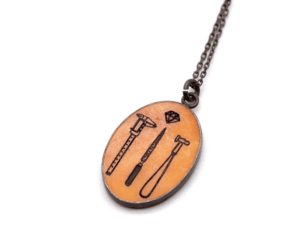
I recently began using diamonds as a way to add the undeniable sparkle they possess to my work. Because diamonds are so eye catching, I think one of the biggest challenges in contemporary jewelry is to allow the work to be the focus, not the stone in it.
The contrast between oxidized silver and the diamonds is quite dramatic, and yet the forms of the pieces are not overshadowed by the stones. In this particular body of work, I have chosen to use diamonds that are quite small, so they are a subtle addition to the pieces; they draw you in to look closer.
May 15th, 2010 09:05
Recently AJF made the decision to enable the comments function on our blog. You, our lovely readers, can now tell us what you think and take part in a stimulating dialog about contemporary jewelry. We have been inundated with responses, and if any of you are interested in finding out more about Russian brides or cheap erectile disfunction medicines, please drop us a line and we can pass on the relevant contacts that have flooded the inbox. Still, as the old proverb suggests, there might just be a pearl along with all the swine, and so we bring you some of the best reader comments and hope that you will enjoy them as much as we did.
Well, thank you very much, Dofus. You are exactly the type of reader we here at AJF are looking for! Who wouldn’t love being told that their blog is so powerful it can change the way people behave on the internet? But what about the question marks? Do they indicate a subtle unease with the concept of beauty within contemporary jewelry practice, and perhaps a suspicion of adornment that wows its audience through trickery rather than a true melding of technical skill and concept?
Well, Dofus, it sounds like you’ve changed your tune a little bit since your first comment! But we sat down and took a serious look at ourselves, and we have to agree. Sometimes it is enough that a piece of jewelry is attractive and well-made. You don’t always have to be searching for deeper meaning. Sometimes a brooch is just a brooch!
It’s always good to know who’s on the market, Surfer Dude, and we’ll keep your ex-girlfriend in mind. Hopefully you can get back all the fantastic contemporary jewelry you gave her during your relationship.
Ffxiv, you need to make up your mind. Jewelry is, at heart, about commitment.
Tracy, that is certainly good advice, and we know our members will certainly treasure it. After all, even those who understand the value of contemporary jewelry appreciate a bargain!
Never a truer word was spoken, Ffxiv! The world of contemporary jewelry is a vast and beautiful one, which you can spend a lifetime exploring and still not understand.
We’re not sure what you have against refreshing the hair of her face, Peter. We do that all the time here at AJF. Still, we like the obfuscatory nature of your prose. Have you considered becoming a contemporary jewelry critic?
May 13th, 2010 10:05
While one jewelry world was meeting at the centre, another was gathering at the western edge. As the Gray Area Symposium celebrated the mixing of North and South in Mexico, the conference titled Resources: Prospects for Contemporary Jewellery & Object Making in Perth, Australia, revealed a more black and white picture in the world of body adornment. (To visit the conference website, click here.)
Formed thirty years ago, the Jewellers and Metalsmiths Group of Australia (JMGA) is defined largely by its biannual conferences. In the past, these international gatherings have served as landmarks, heralding new ideas in the jewelry scene and revealing the unique jewelry scenes in each host city. The last had been in Adelaide, where there had been much talk about the relational paradigm.
This year, Perth – supposedly the most isolated city in the world – had its turn as host. Perth is the state capital of Western Australia, whose sales of raw materials to China are partly responsible for Australia’s relatively soft landing after the Great Financial Crash. But as well as iron ore and gas, the state is also the repository of much of the world’s precious jewelry materials. In Perth itself you can find two or three jewelry outlets in each city block – the CBD seems to drip diamonds and pearls.
The conference theme confronted this extraordinary wealth with a focus on ‘resources’. Glenice Lesley Matthews started with a fascinating overview of the state’s industries of gold, diamonds and pearls. While the Kalgoorlie gold rush has well and truly passed, it is interesting to learn that there are prospecting jewelers who still venture out after the monsoonal rains. After two or three months, they have gathered enough alluvial nuggets to supply their own business.
Diamonds are a massive industry here. By 1983, Argyle diamonds were contributing 40% of world production. The imagination seems to play a critical role in its success. There was much discussion in Perth about the almost psychedelic naming of different diamonds variety – Tiffany & Co. had just bought rights to the canary diamonds from the Allendale mine. What doesn’t feature in the marketing are the cavernous open cut mines in the north-west – so much dug up for such a small result.
Pearling is another lucrative industry and most of the world’s South Sea pearls come from the north-west coast. Matthews spoke caringly about the oysters as ‘animals’ that are farmed for pearls, stressing the importance of healthy and calm habitat. A few in the audience squirmed to see these hard-working animals turned into a hearty meal for pearl workers once their productive life was over. Matthews painted an epic scene of West Australian mining, but it seemed a world away from the new movements like Ethical Metalsmiths.
The conference provided an opportunity to launch the history of West Australian jewelry by Dorothy Erickson. Her impressive tome represents twenty years of work researching the story of jewelry in this far-flung corner of the world. The size of the volume testifies to the depth of jewelry history here: from the struggles of lesser gentry to maintain European lifestyles, to the Linton family’s production of silverware according to Edwardian taste, and the international centre for contemporary jewelry established by David Walker. Sadly, many of her slides were prefaced with a story of their theft from various private homes. It’s a salutary lesson of the critical role played by public collections in preserving this history.
A number of key overseas jewellers came out to talk and give workshops. Fresh from their ‘homecoming’ to New Zealand, Lisa Walker and Karl Fritsch each gave intriguing talks about their idiosyncratic responses to jewelry conventions. Fritsch’s Quixotic story of panning for gold in Germany was quite a contrast to the epic scene in this new world. Helen Britten, who has lived in Perth, outlined the Deleuzian basis of her work as an exercise in ‘slowing down chaos to create a plane of organisation’. Taking the artificial as nature provided an important model of practice in the context of the conference.
There was talk about the place of jewelry beyond body adornment. Melissa Cameron gave a well-considered presentation on the relationship with architecture, which Eugene Keeffer Bell continued with her discussion of the public art of Arthur Paley. There was reference to pre-modern forms in Patricia Anderson’s encyclopaedic overview of classical sources and Maureen Faye-Chuahan’s artist’s talk about Muslim designs.
This outward continued with Oron Catts from the Symbiotica, a laboratory of biological art. Catts gave a sensationalist account of projects that make out of off body tissue. In a similar vein, Rick Spencer’s philosophical paper celebrated subversion in art. As with the Matthew’s tribute to mining, the dominant theme was the adventure of ornament. Whether you see this as bold, or reckless, depends partly on your point of view.
From the other point of view, Elisha Buttler spoke about FORM’s exhibition Signs of Change in which jewellers seek to be creative with ethics. The potential of this curatorial strategy to contest the more libertarian positions was unfortunately lost due to lack of time. But an intimation of where this might lead was evident in a joint presentation by local jewelry elder Bronwyn Goss and indigenous Wongai elder Josie Wowolla Boyle. In an enchanting exchange, they swapped stories of the ‘seven sisters’ found in both Greek and Aboriginal mythologies of the Pleiades. This is the alternative scene to diamonds and pearls in the West – ‘bush jewelry’ produced by artists using materials found directly from the land.
It was a shame the two sides couldn’t come together in debate. Having pushed the ethical barrow myself, I’m aware of the reservations many have about ‘political correctness’. There is the strong Nietzchean strain in contemporary beauty that seeks to defy conventions. Some can argue that beauty itself is a form of subversion which should not be reduced to bland notions such as ‘community’ or ‘sustainability’. How can we engage in the ethical dimension without being completely subsumed by utilitarianism?
As with most such conferences, the success of Resources can be heard in the buzz emanating from dozens of conversations as a contemporary jewelry world comes together to witness each other’s work. Despite the online networks now available like Kit and Caboodle, jewelry in particular seems to still need these kinds of face-to-face encounters to constitute itself as a scene. At their best, they also tell an unfolding story about the relation between body ornament and the world. There are many more stories to tell about how jewelry engages with the epic narrative of Barack Obama, the challenges of Copenhagen, the ascension of emerging nations and the growing clouds of Google, iPhones and Facebook.
May 13th, 2010 01:05
Here at AJF we have spent a bit of time talking about Schmuck, the week of jewelry-related events that takes place in Munich every March. (You can read American jeweler Doug Bucci’s report by clicking here and here, and our recent report from Australian jeweler Zoe Brand by clicking here.) In 2010 one of the notable happenings was the series of exhibitions dealing with contemporary jewelry at Die Neue Sammlung (the International Design Museum) in Germany. (To visit the museum’s website, click here.) The big news was German jeweler Karl Fritsch’s exhibition New in the Danner Rotunda, a purpose-built wing in Die Neue Sammlung’s Pinakothek der Moderne (the Munich branch of the museum) funded by the Danner Foundation.
According to the museum’s publicity:
You can view a video of the opening of Fritsch’s exhibition at the Pinakothek der Moderne by clicking here. And, along with images of jewelry featured in the exhibition, there are a number of images of the exhibition throughout this post that illustrate the sometimes extreme way in which Fritsch has curated (and installed) his survey of contemporary jewelry practice.
We asked Fritsch if he could give us some insight into the way he approached his curatorial duties. He responded: